
A parked vehicle can look completely secure and still move.
On a busy worksite, loading area or transport yard, an unexpected vehicle movement can put drivers, operators and other workers at serious risk. Parking brakes, site procedures and appropriate traffic controls all have a role to play in preventing unintended movement.
Wheel chocks are a simple control that can help keep parked vehicles where they belong, but having wheel chocks on site is only the first step.
They also need to be the right chocks for the job, correctly positioned, and practical for people to use consistently.
At Vanguard, we supply heavy-duty rubber wheel chocks for medium and heavy vehicles, as well as our unique Wheel Chock with Handle & Wheels, developed in response to feedback from customers who wanted a safer, easier way to position and remove heavy wheel chocks.
In this guide, we’ll look at:
- Why vehicle roll-aways are a serious risk
- What WorkSafe recommends about wheel chocking
- What NZ Transport Agency Waka Kotahi says about Cardan shaft park brakes
- When wheel chocks may be appropriate
- How to choose the right wheel chock
- The common mistakes to avoid
- How Vanguard’s Wheel Chock with Handle & Wheels makes chocking easier
Why do vehicles roll away?
Vehicle roll-aways can happen for a number of reasons.
A parking brake may not hold as expected, a vehicle may be parked on a slope or unstable surface, loading or unloading can change the vehicle’s weight distribution, or mechanical failure, incorrect parking procedures or human error can also contribute.
Loading and unloading creates a particular risk because the vehicle is not necessarily in the same condition throughout the process. For example, when a forklift is loading or unloading a truck, the weight and distribution of the load changes with every movement.
Jolting or movement during loading can also affect the vehicle.
The consequences of an unintended vehicle movement can be serious which is why preventing movement in the first place is an important part of managing vehicle-related risks.
What does WorkSafe say about wheel chocks?
WorkSafe New Zealand’s Managing work site traffic – Good practice guidelines provides practical guidance for managing the risks associated with vehicles and mobile plant at work sites. WorkSafe makes it clear that each workplace needs to assess its own risks and determine which controls are reasonably practicable for its situation.
In its section on parking, WorkSafe says parking areas should be on level ground so parked vehicles cannot roll away. Where this isn’t possible, it identifies several controls that can be considered, including wheel stops, positioning vehicle wheels towards a safe stopping place, and chocking the wheels of parked vehicles.
WorkSafe also specifically says that workplaces should have systems in place to prevent vehicles from inadvertently moving or being driven away during loading and unloading. Such examples include:
- Wheel chocks
- Air brake isolation interlock devices
- Vehicle or trailer restraints
- Traffic lights at the loading bay
- Dock locks
Importantly, WorkSafe presents these as examples of controls rather than a blanket requirement to use wheel chocks in every situation. The appropriate controls depend on the risks and circumstances of the individual workplace.
In other words: wheel chocks are one of several controls that can form part of a well-managed vehicle safety system.
What does NZ Transport Agency Waka Kotahi say?
NZ Transport Agency Waka Kotahi has issued specific safety guidance around Cardan shaft park brakes (CSPBs).
These brakes operate on the vehicle’s driveshaft rather than directly on the wheels. NZTA says the risk of a vehicle rolling away is higher when loads change and when vehicles are parked on slopes. Its current safety guidance states that, where a CSPB-equipped vehicle has to be parked on a slope, wheel chocks should be used.
NZTA also recommends:
- Choosing flat, firm ground with good tyre grip wherever possible
- Avoiding unstable surfaces and slopes where possible
- Applying the park brake firmly and fully
- Taking extra care when loading or unloading because changes in vehicle weight can affect the brake’s holding force
- Following the vehicle manufacturer’s instructions
- Ensuring drivers are appropriately trained
- Keeping the park brake correctly inspected, serviced and adjusted
NZTA’s current guidance also states that wheel chocks used with CSPB-equipped vehicles should be centred and at least 25% of the tyre’s height, or at least one quarter of the tyre diameter. It recommends following the chock manufacturer’s instructions and WorkSafe advice.
NZTA’s advice is particularly relevant for operators of trucks and other vehicles fitted with Cardan shaft park brakes. It should be considered alongside the vehicle manufacturer’s instructions and the site’s own risk assessment.
When might wheel chocks be important?
There isn’t one rule that applies to every vehicle and every worksite.
The need for wheel chocks should be considered as part of the overall risk assessment for the vehicle, task and environment.
Some situations where wheel chocking may be particularly relevant include:
Parking on a slope
Level, firm ground is preferable wherever possible.
Where a vehicle must be parked on a slope, the risk of unintended movement increases. Appropriate wheel chocking can provide an additional physical control.
For vehicles fitted with Cardan shaft park brakes, NZTA specifically recommends using wheel chocks if the vehicle has to be parked on a slope.
Loading and unloading
Loading and unloading can change the weight and balance of a vehicle.
This is particularly important when forklifts or other mobile plant are entering and exiting a truck or trailer. Every load movement can change the forces acting on the vehicle.
WorkSafe specifically identifies wheel chocks, vehicle restraints and other controls as examples of systems that can be used to prevent vehicles moving during loading and unloading.
Vehicles with Cardan shaft park brakes
If you operate vehicles fitted with Cardan shaft park brakes, make sure drivers understand how the system works and its limitations.
NZTA’s current guidance recommends wheel chocks when these vehicles have to be parked on a slope and provides specific guidance around chock size and positioning.
Choosing the right wheel chock
Not all wheel chocks are designed for the same application.
Before choosing a chock, consider:
What vehicle is it for?
Is it being used with a ute, truck, trailer or another heavy vehicle?
What size is required?
The chock needs to be appropriately sized for the vehicle and tyre. Always follow the chock manufacturer’s recommendations.
What surface will it be used on?
Consider whether the vehicle is being parked on sealed, smooth, uneven or sloped ground.
How often will it be used?
A chock that is moved once a week presents a different usability consideration from one that workers need to position and remove dozens of times a day.
Who will be using it?
Think about how the chock will be transported and positioned. A heavy chock may be appropriate for the application, but that doesn’t mean it should require repeated lifting and carrying.
That last point is something we hear about regularly.
The problem with heavy wheel chocks
A heavy-duty wheel chock needs enough substance to do its job, but that can also make it awkward to handle.
If someone needs to carry a heavy chock across a loading area, bend down to position it against a tyre, then bend down again to remove it, that process can become physically demanding when repeated throughout the day.
And there’s another important consideration: if a safety control is difficult to use, people are more likely to take shortcuts or avoid using it.
That’s not an argument against using heavy-duty wheel chocks, rather it’s an argument for designing the process around the person who has to use them. And that’s exactly the feedback we were hearing from customers.
The Vanguard Wheel Chock with Handle & Wheels
Our wheel chock with handle and wheels was developed in direct response to market feedback which called for an easier way to deploy wheel chocks.
So we took our large heavy-duty rubber wheel chock and added a steel handle and wheels.
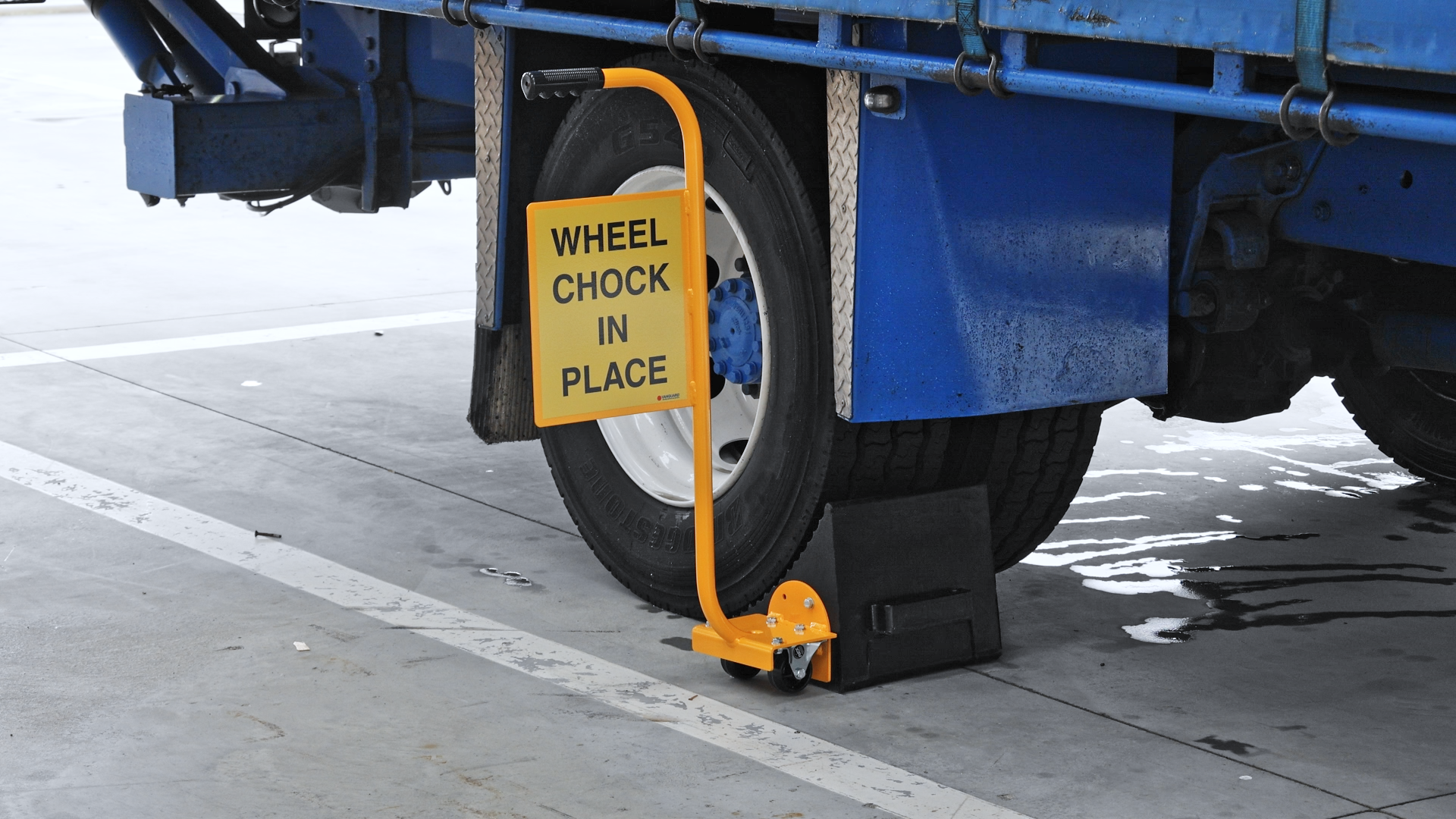
Now, instead of carrying the 12 kg chock to the vehicle, the user can lean it back so the wheels contact the ground, then simply wheel it into position.
Once the chock is positioned against the wheel, the unit sits securely in place.
This was a relatively straightforward development, but it makes a repetitive safety task significantly easier.
Less lifting and bending
The wheeled design means the user doesn’t have to repeatedly carry the weight of the chock or bend down to move it into position.
For sites where wheel chocks are used frequently, this can make a meaningful difference to how easy the control is to use.
Easier to use
The basic process is simple: Lean it back, wheel it into position, and secure the vehicle.
When the vehicle is ready to leave, the chock can be tilted back onto its wheels and wheeled away.
The easier a control is to use, the easier it is to make it part of the normal way of working.
Highly visible
The chock has a large, highly visible sign fitted to both sides of the unit.
That means the driver can see that the vehicle has been chocked regardless of which direction they approach it from.
It also provides a clear visual reminder that the chock needs to be removed before the vehicle leaves.
Left- or right-hand configuration
The handle can be supplied on either the left or right side of the chock, depending on how the unit needs to be positioned in your application.
If you’re unsure which configuration is right for your site, our team can help you work through the application.
Our full range of wheel chocks
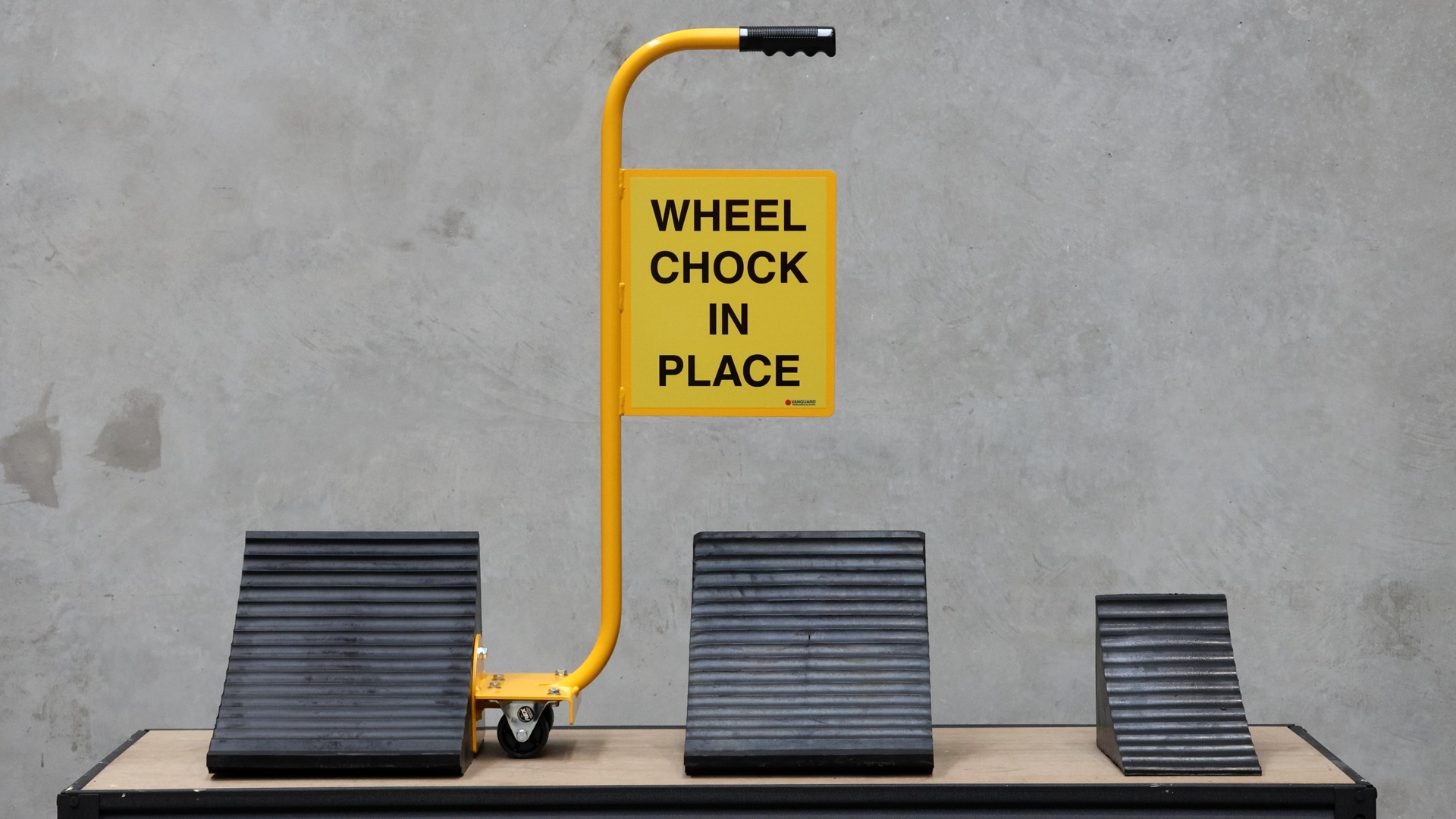
Our Wheel Chock with Handle & Wheels isn’t the only option. We also supply standard rubber wheel chocks for medium and heavy vehicles.
All our rubber chocks are made from heavy-duty recycled rubber and provide good traction against vehicle tyres.
The options include:
Medium rubber wheel chock
Suitable for smaller trucks and utility vehicles, with wheel sizes up to approximately 760 mm in diameter.
Large rubber wheel chock
Designed for larger trucks and heavy vehicles.
Large rubber wheel chock with handle and wheels
The same large rubber chock with the addition of the wheeled handle system for easier positioning and removal.
The right choice depends on the vehicle, application, environment and how frequently the chock needs to be moved.
Common wheel chocking mistakes
A wheel chock is only useful if it is appropriate for the application and used correctly.
Some important things to consider include:
1. Don’t rely on the chock alone
Wheel chocks should not be considered a replacement for the vehicle’s parking brake or other required controls.
Use the vehicle’s parking brake correctly and follow the vehicle manufacturer’s instructions, site procedures and applicable safety guidance.
2. Choose the right chock
A chock that is too small or otherwise unsuitable for the vehicle or application may not provide the intended level of control.
Follow the manufacturer’s specifications and, where relevant, the vehicle manufacturer’s requirements.
3. Position the chock correctly
The chock needs to be positioned correctly against the tyre and in accordance with the manufacturer’s instructions.
For vehicles fitted with Cardan shaft park brakes, NZTA specifically states that chocks should be centred and at least 25% of the tyre’s height when used in the circumstances covered by its guidance.
4. Don’t use damaged chocks
Inspect wheel chocks regularly and remove damaged or unsuitable equipment from service.
5. Don’t drive over the chock
Wheel chocks are designed to prevent unintended movement, not to be driven over.
Make sure workers understand when a vehicle is secured and when the chocks can safely be removed.
6. Make it easy for people to do the right thing
If wheel chocks are being used repeatedly throughout the day, consider how they are transported, positioned and removed.
This is where a handled and wheeled option can make sense.
The bigger picture: practical safety controls
Zooming out from wheel chocks, it’s important to understand that there is no single product that makes a vehicle operation safe.
WorkSafe’s guidance is clear that businesses need to identify the risks associated with their own worksite and determine which controls are reasonably practicable for their situation.
That might mean a combination of:
- Appropriate parking areas
- Vehicle and pedestrian separation
- Parking brakes
- Wheel chocks
- Vehicle or trailer restraints
- Dock locks
- Air brake isolation systems
- Traffic lights
- Signage and procedures
- Worker training
The right combination depends on the vehicle, task, site and people involved.
Need help choosing the right wheel chock?
Whether you need a standard rubber wheel chock or a handled and wheeled option, the right choice depends on your vehicle, application and site.
If you’re not sure what you need, talk to the Vanguard team – we’ll help you understand the options and find a practical solution for your situation.