


If you are a traffic planner, safety engineer, or similar professional, you know that your decisions affect the safety of people in your community. But when your budget has been significantly reduced, it can be hard to prioritise and deliver the road safety improvements you need.
To deliver safe but cost-effective traffic islands, you need to know whether rubber or concrete is the right material for your project.
Choosing the right material isn’t straightforward and the decision depends on several factors. Although we at Vanguard supply rubber traffic islands, we will be the first to say that rubber is not always the right solution! In this article, we’ll explore the differences between rubber and concrete traffic islands, including the pros and cons of both, and how to decide which option works best for you.
By the end, you will be better informed to decide which is the right choice for your project.
Traffic islands: What are they and how do they keep us safe?
Regardless of whether they’re rubber or concrete, traffic islands are raised or painted sections of a roadway to manage and guide traffic on roads. They help improve pedestrian safety by providing a designated crossing point and physically separating vehicles from pedestrians and cyclists, which don’t mix well on most roads!
Types of Traffic Islands
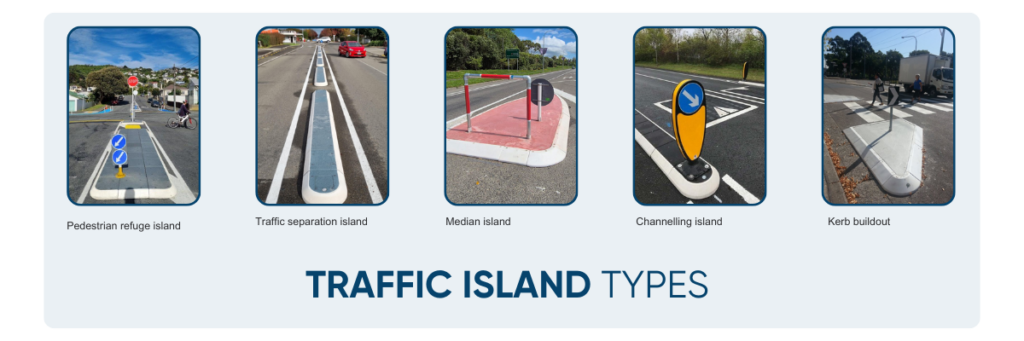
Traffic islands can provide different safety functions for people depending on their location on the road and how they are designed. Below is a simple list of some different types and what they do to improve safety:
- Pedestrian refuge islands keep people safe while crossing the road.
- Traffic separation islands prevent head-on collisions by clearly separating opposing traffic and discouraging lane changes.
- Central/median islands facilitate safe turns and crossings by providing a place for vehicles and pedestrians to wait.
- Channelling islands help organise traffic movements, guide drivers, and reduce the likelihood of crashes by clearly marking desired routes.
- Kerb buildouts narrow the road and force vehicles to take wider turning circles, with the benefit of reducing speeds while cornering.
Choosing the Right Material: What’s Good, What’s Bad about Rubber and Concrete
In New Zealand, most councils build traffic islands from either concrete or rubber or a mixture of both. Concrete is either poured on-site or made from precast edging, whereas rubber islands are made from modular ‘bolt-in’ sections that are relatively lightweight and easy to install. The centre of the island is generally filled with concrete, vegetation, or rubber modules.
Whether built from rubber or concrete, the safety benefits are the same. However, each material has pros and cons. Let’s explore those in more detail below.
Rubber Traffic Islands
Rubber traffic islands are a system of modular components manufactured from recycled rubber, that can be customised for your project. They typically cost less overall than their concrete counterparts, but they don’t last quite as long.
Pros:
- Flexibility: Rubber islands conform to the road surface making them easier to install, and can absorb vehicle impact reducing damage upon contact. If a section is damaged, you only need to replace that module, not the entire island, which makes maintenance fast and easy.
- Cost-effective: Typically, rubber modules are more cost-effective to install, requiring minimal skill, and they can be cut to suit the shape of your project. The installation process also reduces Temporary Traffic Management (TTM) costs.
- Quick installation: The biggest advantage of rubber islands is their short installation time – by bolting them onto the road surface in a matter of hours traffic disruption is minimised reducing traffic management costs. It also means less disruption to the road network and your local community.
- Trials or temporary solutions: If you have limited budget or aren’t ready for a permanent design, rubber can be a great way to trial traffic islands and quickly deliver safety improvements.
- Eco-friendly options: Modular rubber islands are made from recycled rubber and can contribute to your sustainability efforts.
Cons:
- Durability concerns: Rubber may wear down over time and require replacement in 5-10 years, depending on the application.
- Maintenance: Rubber islands may need regular inspection and maintenance to remain functional and safe.
- Stability issues: Compared to concrete it may be more prone to being displaced or damaged by heavy vehicles so it is important to ensure the road surface is in good condition first.
Concrete Traffic Islands
Traditionally, traffic islands were built with concrete, and it’s easy to see why. Concrete is a trusted material with a long lifespan and legendary durability. However, those attributes come with higher material and installation costs.
Pros:
- Durability: Concrete is highly durable and can withstand heavy traffic and adverse weather conditions.
- Low Maintenance: Once installed, concrete islands typically require minimal maintenance compared to other materials.
- Stability: Concrete provides a solid structure less likely to be displaced or damaged by vehicles.
Cons:
- Cost: Concrete can be more expensive due to labour (skill and cost) and traffic management costs with longer installation time.
- Installation time: Concrete takes longer and requires skilled workers to prepare surfaces, set formwork, and pour concrete. Precast concrete edging is faster than this but needs additional epoxy fixing and pinning methods which take time.
- Rigidity: In case of impact, concrete can cause more severe damage to vehicles and may pose a higher risk to pedestrians in accidents. If damaged, you will need to replace the whole structure.
Rubber or concrete: What’s best for my project?
Now you know the differences between rubber and concrete, the next step is to choose which is the best for your project.
While the upfront costs for rubber or concrete material are similar, there are other factors you’ll want to consider before deciding what to use, such as project timeframes, expected traffic volumes, approval processes, and maintenance considerations, which all influence your project’s overall cost and effectiveness.
The great thing about traffic islands is that whether you use concrete or rubber you are going to make your roads safer. You will get safer pedestrian movement, driver guidance, reduced traffic conflicts, and more orderly traffic flow.
Here is a summary to help guide your decision-making:
When is rubber best?
- If you need fast installation with limited traffic disruption
- When retrofitting safety treatments, due to the speed of installation and reduced traffic management costs.
- If you have community or elected member pushback, a temporary rubber solution can help test and measure the concept first.
- If a major intersection project isn’t an option right now, a rubber island can improve safety immediately but won’t prevent future expansion.
Is rubber right for you?
If you are after a cost-effective solution, need to trial traffic islands or put in place a temporary solution, rubber could be a great choice. However, ensure you have a maintenance plan and potential replacement/upgrades 5-10 years down the track.
When is concrete best?
- If you are building large infrastructure.
- If you have concreters on-site already as part of a wider project.
- If you need permanence and low maintenance over the longer term.
Is concrete right for you?
If you are less concerned with installation time and cost and are seeking a long-term solution that withstands heavy traffic with low maintenance then concrete will most likely be best for you.

It’s Time to Get Your Project Started
We acknowledge that councils know their road network better than anyone else. If you’re still unsure about which material to choose, our team of experts is on hand to guide you through the process in more detail to help you get the right outcome for your project. Contact us via the form at the end of this page, or give us a call to start the conversation – we’re here to help!
What’s new?
Check out our latest Roading and Infrastructure catalogue for innovative and cost-effective ways to make your roads safe and efficient.

