

Picture a busy road with 10,000 vehicles travelling through it every day—often, far too fast. At the same time, local residents are trying to navigate the streets, crossing wherever they can to reach local shops, schools, and workplaces.
When speeding vehicles and pedestrians share the same space—without appropriate safety controls in place—accidents happen. It’s a scenario that happens far too often, and one that community members and councils alike desperately want to avoid.
Napier City Council (NCC) and the people of the region faced this exact challenge in 2024 on a popular thoroughfare, Carlyle Street.
The question they were stuck on was this: How could the council trial a better, non-permanent speed-reduction solution that it could test and gather community feedback on before making a final decision?
In the search for answers, the council reached out to our Vanguard team to explore possible options.
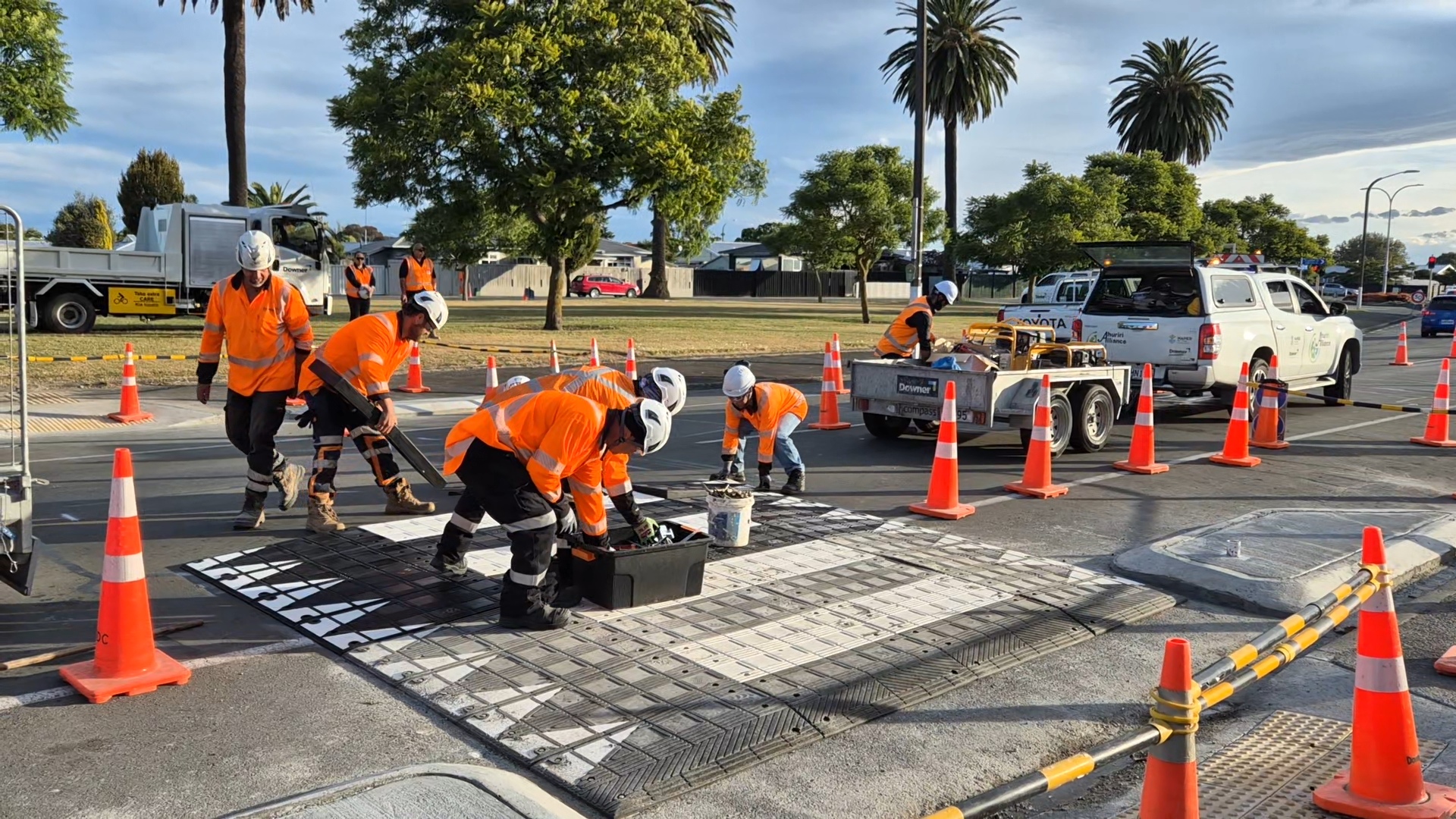
After taking time to understand the situation and to recommend solutions, the decision was made to install two temporary rubber raised pedestrian crossings (also known as modular raised speed tables) in areas where the risk of harm was highest.
In this case study, we examine how this innovative trial enabled NCC to mitigate risk, reduce harm, and secure community support before making a final decision on how to fix the problem.
Project Objectives
Before deciding how to address speed and safety on Carlyle Street council defined three very clear objectives after extensive community consultation, published in their benchmark consultation report:
- Reduce motor vehicle speeds and volumes
- Increase positive feelings of safety for all users, including active modes
- Increase positive perceptions of the urban environment.
The benchmark survey mapped out average speeds, sentiment and modes of travel to provide data-driven evidence for future monitoring.
How Community Support Enabled a Trial
In the past, NCC had always resorted to building permanent raised asphalt crossings. While admittedly cheaper and just as effective from a safety design perspective, they did not allow them to test whether they were effective and, if not, easily removable. Instead, the unsuitable permanent options had to be removed and a new one installed elsewhere—a costly and time-consuming task.
From the many surveys and workshops the council held, members discovered that the community had an appetite for trialling different types of infrastructure to see what would address the speed issue on Carlyle Street. Following consultation with the Vanguard team, the idea to trial two temporary rubber raised pedestrian crossings was floated and put to the community for feedback. During this process, community members were educated on how temporary raised crossings are designed to reduce speed and create a designated road crossing point.
The idea that temporary infrastructure could be moved or adapted if it wasn’t working was very popular and widely supported.
A Temporary Solution: Modular Rubber Pedestrian Crossings
These temporary rubber raised pedestrian crossings were developed after three years of innovative design and consultation among Vanguard, several councils, and industry leaders. Many other councils had also recognised the need for a temporary solution to address safety problems on their road networks.
The temporary solution not only addressed the safety risk but also provided flexibility to move, adapt, and seek feedback on its location and function, ensuring it met the project objectives.
Fast Installation, Less Disruption
A major advantage of using modular rubber platforms is that they are extremely fast and easy to install. It took just six hours to install the platforms on the ground, and the road was open to traffic, minimising temporary traffic management and disruption.
This also meant that the feedback loop and monitoring could begin immediately. From the outset, business owners were happy, pedestrians were happy, and traffic kept moving.
Testing and Feedback Made Easy
With the project moving at a rapid pace and community feedback mechanisms in place from day 1, NCC was able to provide swift updates on the trial’s success.
Two significant issues were raised:
1. The location of one crossing was too far away from the roundabout
2. The crossing junction with the footpath on the other platform was not easily accessible for wheelchairs and other mobility scooters.
Thanks to the rubber crossings’ temporary nature, installers were able to lift and shift the crossing closer to the nearby roundabout, which was another location initially suggested. They also improved accessibility by upgrading the footpath connection.
If the raised speed table had been asphalt and permanent, this would have been an extremely costly and time-consuming exercise, requiring ripping up the asphalt and installing an entirely new speed table. As well as being an inconvenience, this would be a significant waste of ratepayers’ money.
The Benefits of a Trial Approach: Insights From Napier
Using temporary raised pedestrian crossings rather than permanent asphalt tables offered Napier City Council and its community a range of advantages.
These included:
- Allowing for consultation with the community to ensure all parties were satisfied
- The modular design and temporary nature meant the design could be adapted, and the tables could be moved easily
- A try-before-you-buy mindset was encouraged among community members and council members
- Being included meant the community were motivated to provide their feedback
- Confidence in elected council members grew
- The project objectives, to reduce speed and create a safe road crossing, were achieved.
“I personally found it much easier talking to the businesses and residents about the crossings as a trial, and promising to monitor the sites following installation and remove them if we needed to.
There would be much cheaper ways to construct a crossing, but not with the same approach, so I feel it was worth it.” — Owen Mata, Napier City Council

Was the Trial More Cost-Effective?
The cost of the temporary raised pedestrian crossings was higher ($45,000 each) than the cost to build a permanent asphalt raised crossing (around $10-15,000). However, the spend was worth it—not only because it was fast to install, but also because it allowed the community to be involved and saved the council (and its ratepayers) money in the long term.
For more details on how the project achieved its objectives regarding reduced speed and perceptions of safety, check out the Monitoring and Evaluation Reports.
Start a Trial in Your Community
This case study has demonstrated how effective a trial can be for managing speed on a busy street—keeping people safe and reducing the likelihood of accidents—all while keeping the community engaged and part of the process.
If you need speed calming measures on your road network and think a community-centred trial might work, then get in touch with our team today. We can help you get your project started and work with you to make your neighbourhoods safer for more people.
