

Vehicles travelling too fast, in any scenario, can have catastrophic and often irreversible impacts on people, structures, and assets.
Whether it’s a car park, a roadworks site, or a pedestrian crossing, without the right safety controls in place to slow traffic down, accidents cannot be prevented.
Speed calmers are a practical way to slow vehicles in critical areas, but choosing the right type for your site can be confusing, and failing to conduct thorough research can lead to investing in a solution that doesn’t serve its purpose.
In this article, we cover:
- What Are Speed Calmers?
- Things to Consider When Choosing
- Different Types of Speed Calmers
- Which Speed Calmer Is Right for My Site?
Armed with this information, you’ll be able to choose the right speed calming devices for your site, slowing down vehicles and minimising the risk of causing damage and harm.
What Are Speed Calmers?
There are dozens of names for speed-reduction devices—from speed humps to speed bumps, speed calmers, traffic calmers, and if you’re from the UK, even sleeping policemen!—but there are also multiple different types of speed-reduction devices.
At Vanguard, we refer to them as speed calmers, simply because calming speed is exactly what they’re intended to do. While each is designed for different situations, they all share one common purpose: to slow down traffic and prevent incidents.
Where Do You Use Speed Calmers?
Any area that requires speed control to ensure vehicle and pedestrian safety can accommodate a speed calmer. Some common areas you will find them include:
- Driveways
- Business entrances
- Roads
- Carparks
- Loading zones
- Pedestrian walkways
- Blind spots, such as corners
What to Consider When Making a Decision
You’ve either identified that vehicles are travelling through an area too quickly, or you want to put preventative measures in place. With so many options, where do you start? There are a few key questions you can ask yourself to help you in your decision-making process..
1. What Type of Vehicles Are You Trying to Slow Down?
Do you want to slow down trucks entering drop-off zones or light vehicles in a shopping centre car park? No single device can effectively slow down both these vehicles in their respective environments. A speed calmer that’s capable of handling heavy truck traffic is different to what you should use in a carpark where only lightweight vehicles are present.
2. What Speed Are Vehicles Going?
Vehicles are bound to be travelling at a faster speed on a road than in a car park. The location and the associated speed will determine the type of speed calmer you use.
3. Where Are the Speed Calmers Required?
Is it a driveway, road, or pedestrian walkway where you need to slow vehicles down? The location of the site plays a significant role in determining which speed calmer is most applicable.
What Are the Different Types of Speed Calmers?
You now know that one speed calmer can’t slow down all vehicles in all spaces—you have to choose the right one for the type of vehicles using it, the environment the vehicles are in, and what speed they are likely to be going over it. Let’s break down the different types of speed calmers.
Speed Humps
Speed humps are a simple and effective way to slow light vehicles down in carparks, driveways, and other areas. Sometimes called speed bumps, they’re used to reduce speed where cars and people interact, improving safety and reducing risk.
Our modular rubber speed humps are available in 50mm or 75mm high versions to suit different speed and traffic requirements. However, we don’t recommend using these on public roads as they are too abrupt. If you’re trying to slow vehicles on a road, we recommend using speed cushion pads or raised speed tables.
Watch Video: 50mm vs 75mm Speed Humps – How Do I Choose?

Speed Cushions
Speed Cushions are a heavy-duty option designed for use in carparks, loading docks, and other locations where heavy vehicles, such as trucks, are regularly present.
They have a longer profile than speed humps, which helps spread the weight of larger vehicles more evenly across the ground and reduces impact over time.
Our modular rubber speed cushions are available in 50mm or 75mm high versions to suit different speed and traffic requirements.

Speed Cushion Pads
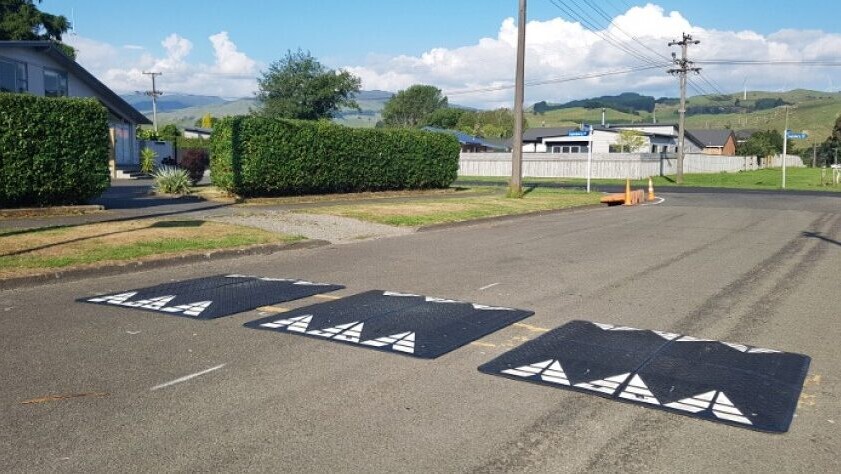
Suitable for heavy-duty vehicles and forklifts, speed cushions are the right solution for shared routes with diverse industrial traffic and frequent heavy loads.
180mm in width, they are designed to slow standard vehicles while allowing emergency vehicles like fire engines and ambulances to pass over unhindered.
Related: Speed Hump vs Speed Cushion – What’s the Difference, and Which is Right for Me?
Raised Speed Tables
Modular raised speed tables are the most effective device for slowing all vehicle speeds on roads because they extend across the full width of the road.
Our system is entirely modular, allowing you to build a platform as wide and long as needed to slow down vehicles, with the added benefit of providing a safe crossing point for people.
This system can be configured to either be a zebra crossing or a plain black raised speed table.

Rumble Strips
Rumble strips are a speed warning device rather than a speed calming device. They’re designed to alert drivers to changing road conditions ahead of them and give them time to react and reduce speed.
You’ll typically see them in car parks, driveways, or sometimes on the approach to a roundabout or intersection, providing early warning to motorists.

Temporary Portable Rumble Strip
Temporary Portable Rumble Strips alert drivers to changing road conditions and imminent work zones. They are placed ahead of the site to give drivers time to react and reduce their speed before reaching the site.
Our version, known as the RoadQuake® 2F, is a portable, self-weighted, folding rumble strip explicitly designed to address the risk of distracted drivers breaching a temporary work site at high speeds.
This durable and easy-to-deploy system is great for temporary use in various environments and conditions, and is suitable for all vehicle types.
Traditional portable speed humps can only be used in 30kmh reduced speed zones, whereas these rumble strips are designed to be used on 100kmh motorways. They generate the same sound and vibration as traditional ‘milled-in’ or permanent rumble strips.

Choosing the Right Solution for the Right Application
Whether it’s a speed hump or rumble strip, every speed calmer serves a specific purpose depending on your traffic flow, vehicle types, and safety needs.
If you’ve been struggling to decide which solution best fits your site, you’re not alone. Many businesses face the same challenge when trying to balance effectiveness with practicality.
Now that you understand the differences, you’re equipped to make an informed, confident decision that keeps people, structures and assets safe and protected.
Looking for further advice? Get in touch with us and we’ll help you find the right speed reduction solution for your situation.
