


If you’re looking to slow traffic in a carpark, driveway, warehouse or private site, speed humps are one of the most effective tools available. But choosing the wrong height will either fail to slow vehicles enough, or give drivers a harsh jolt where a gentler option would have done the job.
This guide covers whether a speed hump is right for your site, what height differences actually do, and which one suits which situation.
In this article:
- Quick answer: 50mm or 75mm?
- What is a speed hump?
- Is a speed hump right for your site?
- Why height matters
- When to choose the 50mm speed hump
- When to choose the 75mm speed hump
- Cost, installation and lifespan
- What if a speed hump isn’t the right fit?
Quick answer: 50mm or 75mm?
The 50mm and 75mm in the product names refer to the height of the speed hump. The taller the hump, the slower a vehicle has to go to cross it comfortably.
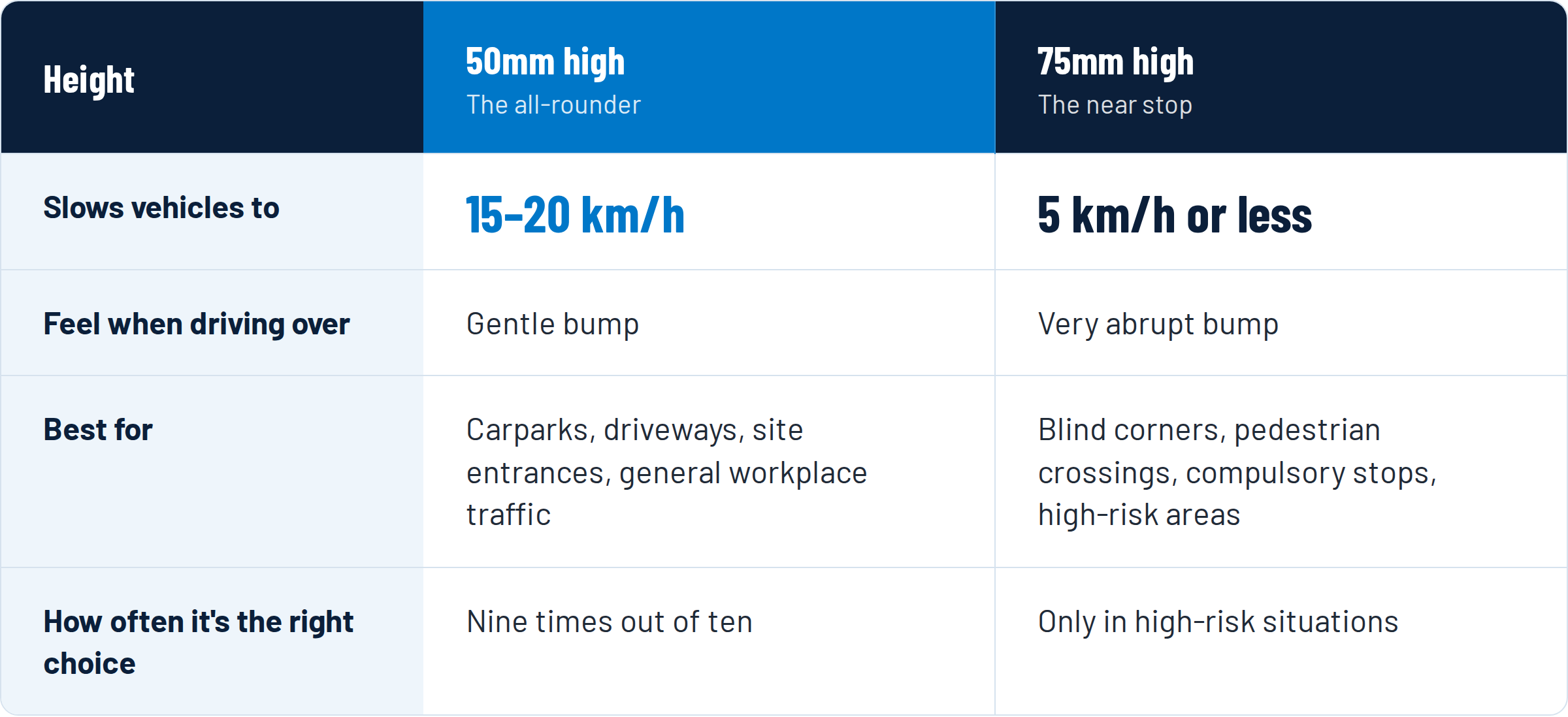
In short: the 50mm-high speed hump is the right choice for most sites. Only choose the 75mm-high speed hump where vehicles genuinely need to come to a near stop.
Watch the comparison video below to see the difference for yourself.
What is a speed hump?
A speed hump is a highly popular and effective speed calming traffic safety device used to reduce the risk of collisions between people, vehicles and assets.
Typically, a speed hump is a raised obstruction fixed across a traffic lane, such a road or driveway, that creates a ‘bump’ to drive over.
Speed humps are the most popular speed calming device we supply. Our interlocking rubber speed humps are fully modular, with a tongue-and-groove system that adds strength and durability while making installation fast. They come in two heights: 50mm and 75mm.
Is a speed hump right for your site?
Speed humps are designed to slow standard-sized vehicles, such as cars, utes, vans and small trucks, to between 0 and 20 km/h. They work well in:
- Carparks at shopping centres, supermarkets, recreational areas and businesses
- High pedestrian areas where people regularly cross or walk along the roadway
- Exits onto busy roads where vehicles need to slow before joining traffic
- Private property and warehousing where you need to manage speed to protect staff
- Quieter roads, such as residential streets with low traffic volumes
Because the bump is abrupt, we don’t recommend speed humps on main roads or public roads, or for slowing heavy vehicles such as large trucks and buses. For speed calming on public roads, Speed Cushion Pads or Raised Speed Tables are a better fit.
Why height matters
Side by side, 50mm-high and 75mm high speed humps don’t look dissimilar, but driving over them is a different story.
The 50mm-high speed hump is a gentle bump that slows vehicles to 15–20 km/h. It forces drivers to slow down, but still keeps traffic moving.
The 75mm-high speed hump is a very abrupt bump that slows vehicles to 5 km/h or less. It forces drivers to come to a near stop, or they’ll feel a large jolt that’s both uncomfortable for the driver, and potentially damaging to the vehicle.
That’s why the height of the speed hump is a much more important decision than most people think. If it’s too low, vehicles won’t slow enough where the risk is high. If it’s too high, you’ll be giving drivers an aggressive jolt and holding up traffic flows.
When to choose the 50mm speed hump
The 50mm-high speed hump is our most popular speed hump and a great all-rounder. It slows vehicles to around 15–20 km/h without being overly disruptive. It’s a good choice for:
- General traffic calming in carparks, supermarkets, shopping centres and driveways
- Site entrances where traffic moves from public roads onto private roads with a lower speed limit
- Carparks with speed limits where you want drivers to stay within a reasonable speed
- Sites with a mix of vehicles (but not trucks), including cars with lower ground clearance
Things to consider: the 50mm height may not be enough in high-risk areas or where vehicles need to come to a near stop, such as blind corners.
Watch the video below to see the 50mm-high speed hump in action.
When to choose the 75mm speed hump
The 75mm-high speed hump is the most extreme option for speed management. Its abrupt profile slows vehicles to 5 km/h or less, giving an immediate and significant speed reduction. It’s designed for:
- High-risk areas, including locations with a history of collisions or near misses
- Blind corners with limited visibility, where vehicles need to slow dramatically
- Pedestrian crossings and compulsory stops where vehicles must come to a near stop
- Very low-speed environments where vehicles need to travel at a crawl
Things to consider:
- Vehicles with low ground clearance will find 75mm speed humps a challenge
- They can be uncomfortable for drivers who don’t slow down enough, so we don’t recommend them for busy public carparks unless the situation is high risk
Watch the video below to see the 75mm-high speed hump in action.
Cost, installation and lifespan
How much do speed humps cost?
As a guide, you can expect to pay:
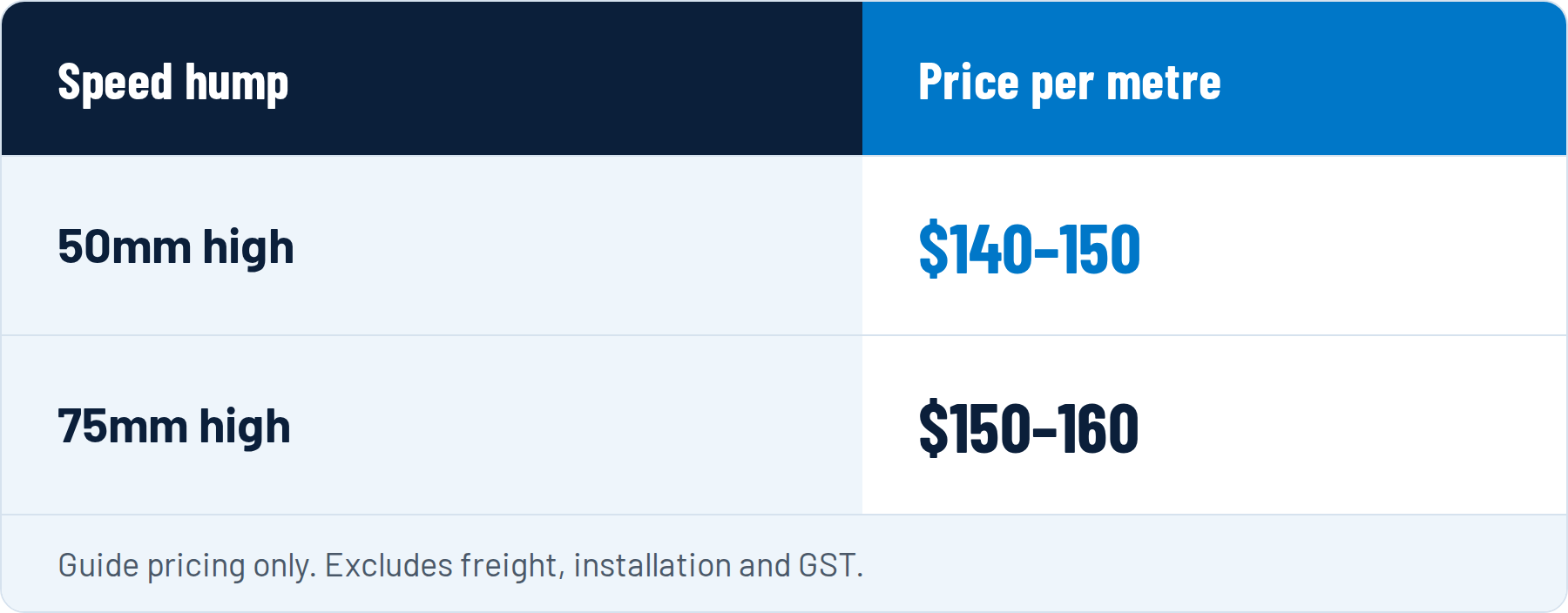
Please note, these prices are just a guide and exclude freight, installation and GST.
Your final cost depends on how wide the speed hump needs to be, how many you’re installing, the surface you’re installing onto, what fixings you require, and whether you need glue. We recommend glue for sites with lots of heavy vehicles or high traffic volumes.
If you already know the height, quantity, and fixings you require, get in touch now and our team can prepare an accurate quote. Likewise, if you’re unsure what height you require and need some advice before proceeding further, please get in touch to talk to our team about how to choose the right speed hump for your situation.
What to know about installation
Our rubber speed humps can be installed on asphalt, concrete or chipseal. If your surface is cracked, rutted or potholed, repair it first, as installing on damaged ground can make matters worse and reduce the effectiveness of the speed hump.
The system is completely modular so they can be configured to fit any width. Modules are measured in width (kerb to kerb) rather than length. Centre modules are 500mm wide and end caps are 200mm wide. The modules are designed with interlocking technology to connect securely together and are screwed or bolted down for extra strength and durability.

How long do speed humps last?
In typical conditions, most speed humps will last at least five years. Choosing the right height for the job, installing it properly and keeping heavy vehicle traffic to a minimum all extend that lifespan.
Regular checks for damage and re-tightening loose screws will help too. If a module is damaged, you can replace just that piece quickly and easily, which keeps maintenance costs down.
What if a speed hump isn’t the right fit?
Speed humps aren’t the answer for every site. The right speed calming device depends on your environment, the type and volume of traffic, and what you need to achieve. Before you decide, check:
- Risk: where are the hazards, and where do you need speed reduction most?
- Vehicles: what will use the area – cars, trucks, buses, forklifts?
- Pedestrians: will people need to cross or walk through the area?
- Surface: are you installing on asphalt, concrete or something else, and what condition is it in?
- Regulations: are there local rules or guidelines you need to comply with?
If a speed hump doesn’t suit, our complete guide to speed calmers covers the other options.
Still not sure which height is right, or whether you need a speed hump at all? Get in touch and our team will help you work out the right solution for your site.
