

A high crash risk and intense community pressure are two major motivators for change when you’re in charge of keeping people safe and traffic moving smoothly.
But what if you don’t have a million-dollar budget to solve the problem?
This was the case for New Zealand Transport Agency (NZTA) Waka Kotahi when a dangerous intersection in the Waikato region became the site of severe traffic buildup and numerous crashes—one of which was fatal.
The road leading to and from the intersection is a popular route for tourists and locals alike, who travel from near and far to visit Hobbiton.
Located near Matamata on SH29-Hopkins Road, the intersection was identified as a danger hotspot by NZTA, but securing millions in funding for a permanent upgrade wasn’t immediately possible.
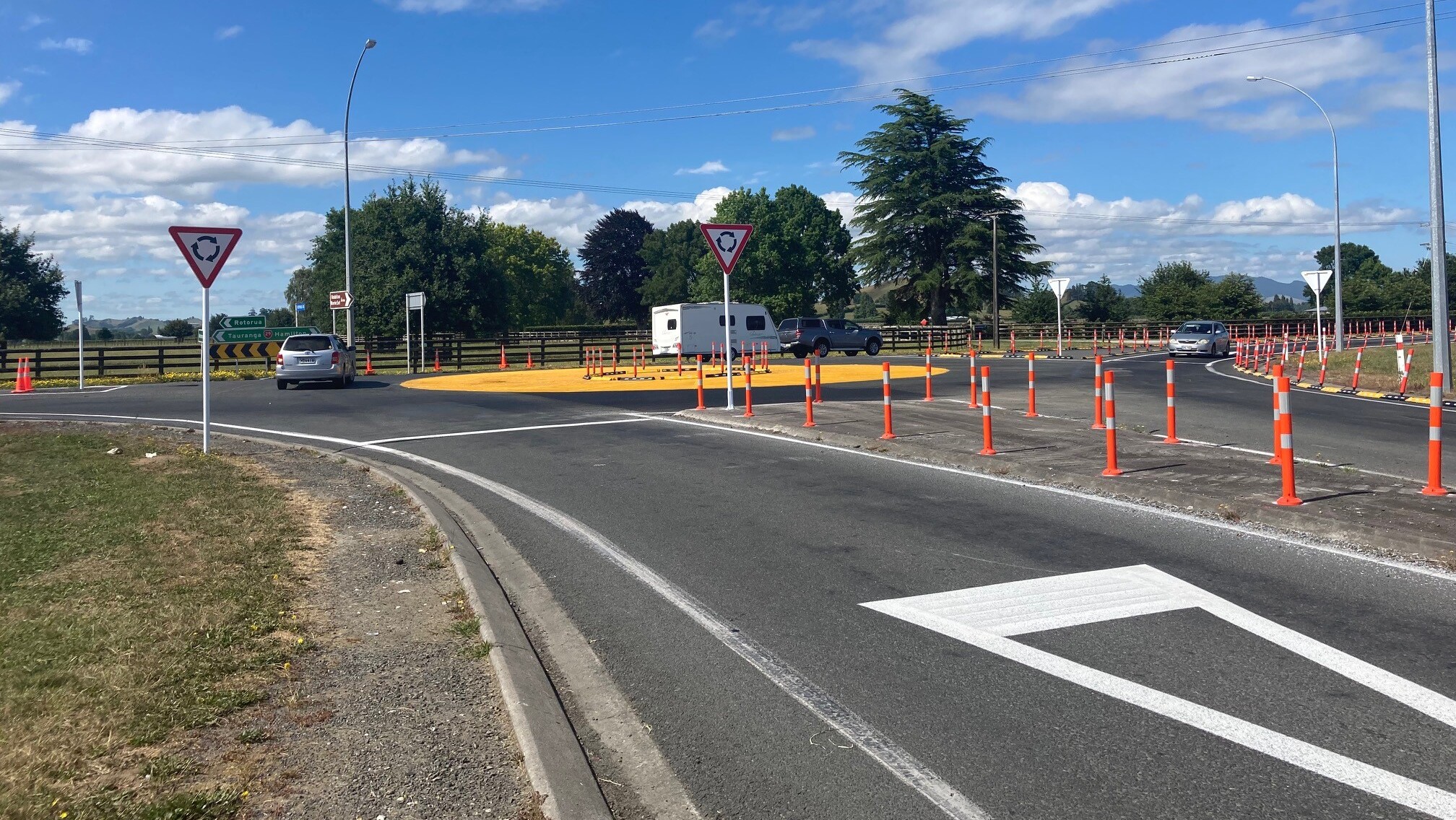
When a nearby bridge closure diverted more traffic through the intersection, the opportunity to trial a temporary roundabout using flexible traffic separators could not have come at a better time.
The purpose of implementing these temporary safety controls was clear: reduce crash risk, slow vehicle speeds, and gather real-time performance data.
The data gathered from the site allowed NZTA to compare the cost and effectiveness of these three options directly:
- Maintaining the temporary roundabout
- Upgrading to a mid-term temporary roundabout
- Investing in a permanent roundabout (and what size this could be).
In this article, we follow the temporary roundabout process from the decision stage, right through to installation, monitoring and outcome.
What we cover:
- Why did the site need safety controls?
- How was the temporary roundabout created?
- Did the temporary roundabout trial work?
- Temporary, medium-term, or permanent roundabouts: Which is best?
What Were the Risks Associated With the Roundabout?
Due to a lack of safety controls, one of the biggest risks at the SH29/Hopkins Road intersection was drivers pulling out at unsafe times, resulting in collisions with other vehicles.
Over five years (2014–2018), one fatal crash, three serious injuries, two minor injuries, and three non-injury crashes were recorded at the site. High daily traffic volumes also added to the level of risk.
Residents and local businesses had been calling for a roundabout for years, describing the intersection as a “time bomb.” Despite this, it is yet to be prioritised for funding due to competing demands and the estimated $9 million cost of a permanent roundabout, or the $5 million cost for a smaller alternative.
Initial safety upgrades included the 2019 installation of a Rural Intersection Activated Warning System (RIAWS) to reduce speeds from 100km/h to 60km/h on SH29 when triggered by a vehicle on the side road. While helpful, many vehicles continued to travel above safe system speeds, as confirmed by local feedback.
How NZTA Turned a Detour Into an Opportunity
A planned bridge closure nearby created the perfect window to test a temporary roundabout and address the community’s valid safety concerns.
In early 2022, travellers faced a scheduled three-month closure of the Mangawhero Stream Bridge. As a result, this would reroute a high volume of traffic through the intersection. With the risks heightened even further, NZTA recognised that a better solution had to be put in place.
After discussing safety solutions with our team at Vanguard, NZTA went ahead with our recommendation to trial a low-cost, temporary roundabout, constructed using lane delineators.
Implementing the temporary roundabout solution, reducing the speed limit to 50km/h, and using temporary signage provided NZTA with valuable insights into how effective a roundabout would be—before committing to an expensive, permanent solution.
The trial allowed NZTA to:
- Reduce speed throughout the intersection area
- Measure vehicle speeds and driver behaviour using drone footage and traffic counters
- Assess the layout effectiveness for heavy vehicles, like trucks
- Engage with the local community to gather feedback on the installation.
How Did the Temporary Roundabout Improve Site Safety and Efficiency?
The temporary roundabout at SH29/Hopkins Road was monitored using drone footage, fixed cameras, speed loop counters, and site visits over a period of 6 weeks, starting in February 2022.
During this initial phase and beyond, the installation showed marked safety improvements across every key metric.
Speeds dropped significantly
Median speeds during the trial ranged from 34.7 km/h westbound to 39.2 km/h eastbound, which is well within the safe system limits for side-impact crashes.
Reduced crashes to zero
No crashes were recorded during the observed trial period, which included over 9 hours of continuous footage review and a dedicated night audit. Only one minor near miss was detected, with no injuries or risky behaviours observed across the monitoring sessions.
Conflict points reduced
The roundabout geometry helped eliminate high-speed angle crashes typical of rural T-intersections, replacing them with lower-risk merging movements.
Traffic moved efficiently
No congestion or delays were reported during day or night audits, and heavy vehicles, including large trucks, navigated the layout with sufficient clearance.
RIAWS versus Temporary Roundabout
While RIAWS addressed only speed, the roundabout reduced speed, conflict points, and decision complexity — key considerations for intersection safety.
The data confirmed that the temporary infrastructure outperformed electronic signage, especially on rural intersections where visibility, reaction time, and driver predictability matter most.
The trial showed that even with less-than-ideal deflection geometry, the combination of a temporary roundabout and a temporary 50 km/h limit created a measurably safer environment than the original uncontrolled intersection.
Which Option Works Best: Temporary, Medium-Term, or Permanent Roundabouts?
Using the insights gained from the trial, NZTA and project partners did a high-level comparison for three roundabout options.. These ranged from low-cost, short-term solutions to full-scale permanent infrastructure. Each with different costs, safety, and maintenance trade-offs.
The table below highlights key comparisons (noting that the costs are indicative and are in context to the SH29 / Hopkins Road site).

Choosing the best option for your intersection upgrade depends on available budget, timeframes, and risk tolerance. If you need help working out which type of roundabout is right for your site, we’re here to help.
Get in touch so we can understand your situation and provide you with solutions that are fit-for-purpose and meet your project cost and time requirements.
Takeaways for Councils and Road Authorities
The SH29 project proves that temporary infrastructure can deliver measurable safety improvements, valuable data, and smarter investment decisions.
This case study offers more than just a successful safety trial; it provides a repeatable model for councils and agencies facing similar challenges:
- Limited funding
- High-risk intersection
- Mounting community pressure
Four key lessons learned:
1. Temporary doesn’t mean ineffective
The trial roundabout delivered lower speeds, reduced crash risk, and smoother turning movements, all at a fraction of the cost of a permanent installation. Even with non-ideal deflection and basic materials, the safety performance outpaced prior RIAWS results and “do nothing” scenarios.
2. Real-world trials provide real-world data
Drone footage, speed counters, and observational audits gave NZTA high-quality insights on:
- Speed profiles for all approaches
- Conflict point reduction
- Vehicle tracking for large and light vehicles
- Community and operator feedback
This data-informed approach helps justify future investment decisions and refine permanent design choices.
3. The project enabled early intervention and flexibility
The roundabout also served a dual purpose—it mitigated risk during the SH27 detour while enabling a medium- to long-term infrastructure conversation to evolve. The use of modular lane delineators allowed for changes to be made quickly as insights emerged.
4. Community trust improves when action is visible
Residents and local stakeholders had long demanded action. The trial sent a clear message that safety concerns were taken seriously, without waiting years for funding of a permanent intersection upgrade.
Summary:
Temporary infrastructure trials like this one allow road authorities to act faster, learn more, and spend smarter, without prematurely locking into long-term commitments (or not doing anything at all).
Do You Need to Manage a High-Risk Intersection?
If you’re facing safety concerns at a rural intersection, trialling a temporary roundabout could be your smartest next step.
Not every site will be ready or funded for a multi-million-dollar permanent roundabout. But that doesn’t mean people need to die or face serious injury while you wait to improve safety.
If you’re a council, road safety engineer, or interested stakeholder, and you’re managing intersections that:
- Have a known crash history
- Sit on high-speed, rural corridors
- Are under pressure from local community groups to take action
- Lack of funding for permanent upgrades.
… then a temporary or semi-permanent roundabout trial offers a way forward.
Temporary roundabouts, flexible lane delineators, and semi-permanent designs offer a way to protect lives, validate designs, and move forward confidently.
Start with a low-cost installation, monitor the outcomes, and scale up with evidence in hand.
Whether you’re exploring a short-term fix, a medium-term upgrade, or simply need support planning your first pilot, give us a call—we can help you get started.
Related: “Think Before You Pour: Why More Councils Are Trialling Rubber Roundabouts.”


