
Safety bollards play a big role in keeping people and assets safe in environments where people are working, vehicles are moving, and expensive assets require protection.
From energy-absorbing bollards to surface-mounted, in-ground, and stainless steel options, there is a whole range to choose from. But with so much choice, how do you know which bollard will be the most effective for your site and situation?
In this article, we’ll cover:
- What are safety bollards used for?
- Where are bollards used?
- Different types of safety bollards, cost, and use cases
- Which bollard is right for my site?
Armed with this information, you’ll have everything you need to select bollards that are fit for purpose, protect your people and assets, and save you time and money in the long run.
What Are Safety Bollards Used For?
While initially designed for mooring boats, bollards now have a variety of uses beyond their salty origins. Whether you’re using a bollard to control access points, prevent impact damage, or separate pedestrians from vehicles, they’re a practical safety solution for busy work sites and public spaces across the board.
There is a wide range of different bollards, all of which are designed for different applications and situations. Choosing the right one for your site comes down to:
- Being clear on what you need the bollards for (what is the risk)
- The kind of environment they are being installed into (where is the risk)
Where Are Bollards Typically Used?
If you haven’t installed bollards before or are unsure if you’ve got the right bollard in the right place, you’re not the first to wonder. There are specific bollards for specific situations.
Some common uses include:
- Bollards for roller door protection
- Bollards for walkway protection
- Bollards for asset protection
- Bollards for storefront protection.
Not every bollard is going to offer you the same level of protection—it has to be matched to the level of risk in the area it’s being installed in.
A stainless steel bollard, for example, is great as an aesthetic bollard for public areas, but doesn’t offer the protection and durability required for the likes of an industrial warehouse where vehicles are likely to hit it. Much like an energy-absorbing bollard is designed to withstand repetitive impacts from forklifts and other material handling equipment, but would be over-engineered for an area where repetitive vehicle impact is unlikely.
Key Considerations When Choosing a Bollard
So, you’ve identified the need for safety bollards to protect people and assets on your site. What’s next? There are some key things to consider when choosing the right type of bollard for your site. These include:
- Risk level: What are you protecting? People, assets, traffic flow?
- Environment: Indoors vs outdoors, weather, corrosion.
- Traffic types and speeds: Pedestrian zones, forklifts, or heavy trucks.
- Temporary vs permanent: Do they need to be removable for occasional vehicle access?
- Impact testing: Do you need a bollard to withstand vehicle impact, or are you just delineating and not protecting
- Maintenance and lifespan: Whole-of-life cost – upfront cost vs maintenance/ongoing costs
Problems to Avoid
When installing a bollard without considering the above factors, assets and people could be at greater risk of damage or injury. Plus, the solution you install may not last the distance. Below are some essential things to be aware of when deciding which option is best for your site.
- Over-specifying: choosing something that is too heavy-duty for your situation can be unnecessary and result in a higher cost.
- Under-specifying: bollards that bend, fail, or don’t protect what you need them to.
- Installation errors: wrong spacing, shallow foundations, or installing into asphalt instead of concrete can affect strength and durability.
- Site workflow impacts: blocking access in the wrong places, slowing operations down altogether.
Types of Safety Bollards: What’s the Difference?
Let’s explore the different types of bollards and what makes one different from the next.
Steel Bollards
Steel bollards are often the first thing that comes to mind when you think of bollards. Choosing a steel bollard option is a highly effective way to reduce harm and damage from vehicles by acting as sturdy physical protectors for pedestrians and assets, serving as visual deterrents, and/or providing traffic calming cues for drivers. They’re a common choice and come in surface-mount and in-ground options.
Surface Mount Bollards
Surface-mount steel bollards are bolted into a concrete surface to protect pallet racking, door tracks, corners of walls, buildings, and more. They’re quick to install and easy to remove/replace if they are significantly damaged.
If your existing surface is asphalt, to optimise bollard strength, we recommend providing a concrete footing for bolting it into place.
Price Range: $215.00- $295.00 (depending on size and colour)
Sizing and finish options

Surface Mount Bollards (Removable)
Surface-mount removable bollards are a two-part system, with a surface mounting plate and a detachable bollard that twists in and out for easy attachment and removal. They also come with a key-lock system to secure the bollard in place when in use.
Price: $637ea
Sizing and finish options

In-Ground Bollards (Ram-raid bollards)
In-ground steel bollards are concreted into the ground for maximum protection. Casting them into concrete makes them a lot stronger than surface-mount bollards; however, they are more time-consuming to install. Typically, in-ground bollards are best installed when pouring new concrete slabs as part of a project. If you have an existing concrete slab, you might want to explore surface-mounted bollards.
Price Range: $205-$315 (depending on size and colour)
Sizing and finish options

In-Ground Bollards (Removable)
While in-ground bollards are more difficult to remove entirely than surface-mount bollards, they do come with a detachable bollard option. When removing the bollard, the ground sleeve hinge neatly covers the opening, making it safe for vehicles and pedestrians to travel over.
Price Range: $535-$565 (depending on size and colour)
Sizing and finish options

Stainless Steel Bollards
Stainless steel bollards are particularly suited to areas where aesthetics are important, such as shopping centres, marine environments, food-grade factories, warehouses, and airports. Used as a visual deterrent, they come in three different styles.
Stainless Steel Surface Mount Bollard
A surface-mount stainless steel bollard can be installed by bolting it into an existing concrete surface, avoiding the need for drilling a hole in the ground. They are easier to remove than in-ground bollards in the event of damage.
Price Range: $578-$1038 (depending on size and colour)
Sizing and finish options

Stainless Steel In-Ground Bollard
An in-ground stainless steel bollard is ideal for use in areas where a base-mounted bollard would be impractical due to space constraints or aesthetic requirements. Concreted into the ground using a heavy-duty ground sleeve, they offer more strength and protection than a surface mount option.
Price Range: $604-$776 (depending on size and colour)
Sizing and finish options

Hidden Base Stainless Steel Bollard
Stainless steel bollards with a hidden base are still surface-mounted; however, they are an even more subtle alternative. The hidden base means there is no mounted plate on display. Instead, the stainless bollard tube slots down over the flange and is attached with small socket screws.
These bollards in particular are often used in airports to prevent pedestrians from taking baggage or trolleys through restricted areas. They act as a physical barrier that reduces tripping risk, while also offering aesthetic appeal.
Priced per custom project design. Contact us to discuss your project requirements.

Energy-Absorbing Bollards
An energy-absorbing bollard is made from either steel or flexible materials and works to absorb impact when hit.
Steel Energy-Absorbing Bollard
Steel energy-absorbing bollards offer a heavier-duty alternative to standard steel bollards. Designed to control errant vehicles attempting to enter a pedestrian area, they are impact-tested against vehicles weighing up to 1,600 kg and traveling at 60km/h. Surface-mounted into concrete, they absorb collisions via an elastomer base that tilts up to 20°, then resets upright.
Ideal for commercial, industrial, logistics, and traffic control settings, they serve as a physical barrier and can help reduce damage in the event of a collision. The energy-absorbing function also prevents the bollard from ripping out of concrete surfaces when struck, thereby avoiding costly ground repairs.
Priced per custom project design. Contact us to discuss your project requirements.

Flexible Energy-Absorbing Bollards
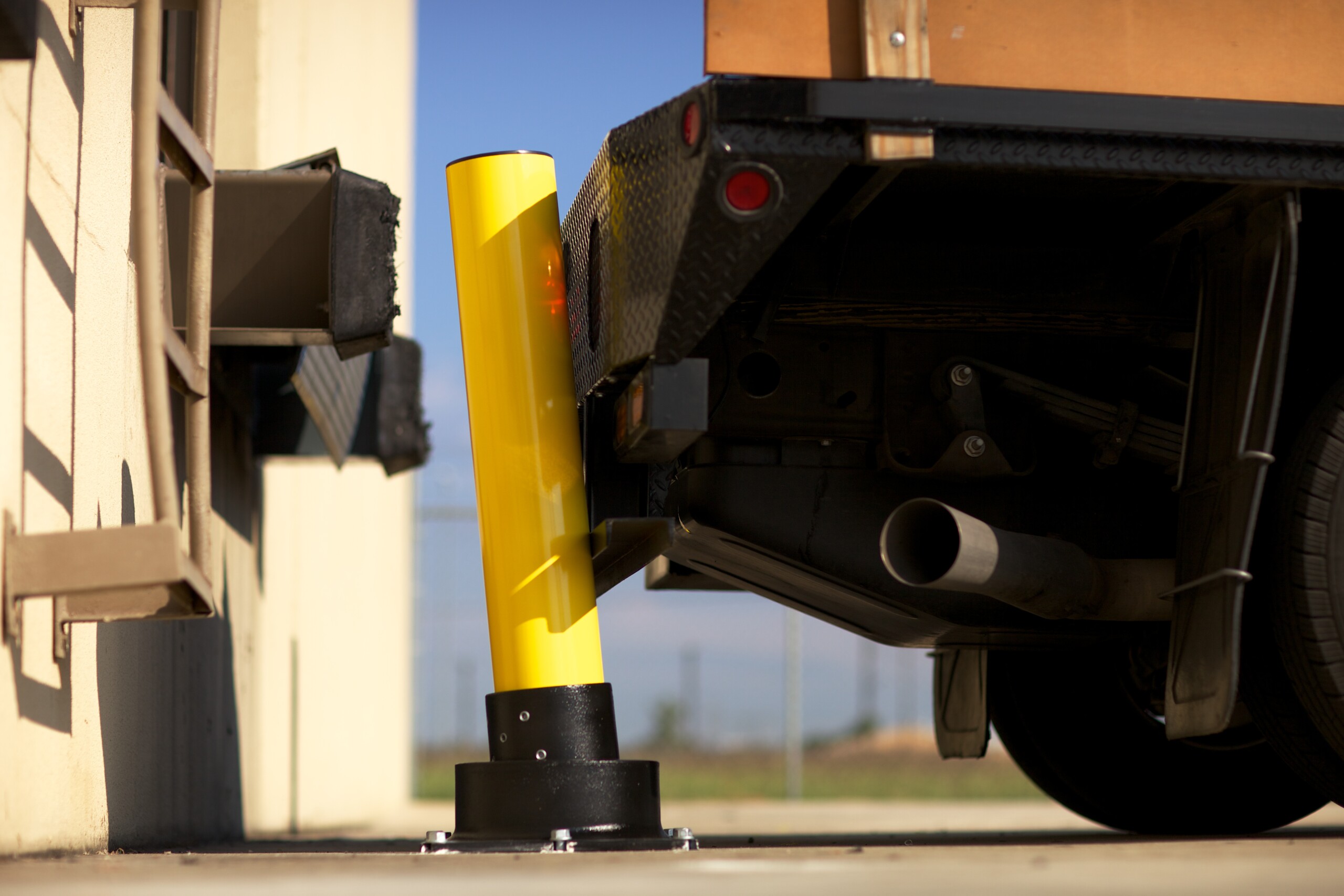
Flexible energy-absorbing bollards are built to do exactly as their title states—flex, absorb impact, and return to their original shape when hit by vehicles, forklifts, and other material handling equipment (MHE).
An effective solution for protecting assets such as doors, entrances, corners, and machines from impact, there are multiple designs with different base mechanisms, but they all achieve the same goal.
While a higher upfront cost than steel bollards, they significantly reduce long-term maintenance costs, making them a smart safety investment.
Price Range: $700-$2,290 (depending on type and configuration)
Sizing and finish options
Flexible Bollards
Flexible bollards, also known as hit sticks, are ideal for lane delineation and guiding vehicles—both in workplaces and on roads. Designed to withstand multiple hits, they return to their original state on impact.
Price Range: $50-150 (depending on type)
Sizing and style options

Steel Bollard Finishes: Galvanised, Powder-Coated or Both?
Steel bollards are available in a range of finishes, each offering different layers of protection and visibility. Let’s break down those differences to help you in your decision-making process.
Galvanised:
Galvanised steel is a popular choice for strength and corrosion protection. This finish is intended for external areas outside buildings, wet areas, and wash-down areas to prevent rusting and corrosion. The zinc-iron coating protects the base steel, meaning it lasts longer in corrosive environments.
A protective zinc coating is applied to the raw steel, typically using a hot-dip system where the parts are submerged in a bath of molten zinc. In some cases, electroplating or spray arc galvanising may also be used.
The main downside of galvanised steel bollards is that they are low-visibility, increasing the chance of accidental collisions.
Galvanised with Yellow Powder Coat (Galv/Yellow):
Galvanised steel bollards with a yellow powder coat undergo the same galvanising process as standard galvanised bollards; however, they are additionally powder-coated (typically in yellow) to enhance visibility and create a polished finish. The high-visibility yellow is well worthwhile, with the chance of accidental impact being reduced by 80% compared to the basic galvanised-only finish. Custom powder coating is also an option for specific projects.
Bollards Compared: Which Is Best for Your Site or Project?
At the end of the day, choosing the right safety bollard isn’t just about picking a product and sticking it in the ground. It’s about understanding which bollard is right for your situation and is going to perform the way you need it to. That way, you can create a safer, more efficient work environment where people and assets are protected from preventable harm.
By understanding what each bollard offers and matching that to your site’s risks, layout, and traffic, you can make an informed decision that saves time, money, and future frustration.
If you’ve been unsure which bollards to install or you’re worried about over- or under-specifying, you now have the tools to confidently assess your site and select the option that best fits your safety goals.
If you’d like further support in choosing the right bollard for your site, contact our team of experts, who can help you find the ideal solution for your project.