

Unlike standard steel bollards, energy absorbing bollards absorb impact when hit and return to their original shape. Thanks to their flexibility, they can withstand collisions with machinery and confidently protect assets, saving you significant time and money.
But there’s not just one type of energy-absorbing bollard—they all offer different levels of impact protection based on size, structure, and material.
In this article, we explore the difference between Boplan and SlowStop energy absorbing bollards to help you determine which model could be the right solution for your site.
Could energy absorbing bollards be over engineered for what you need them to protect on your site? Maybe all you need is a standard steel bollard.
In our article “Tired of Replacing Damaged Bollards? You Might Be Using the Wrong Type”, we cover the features of standard steel bollards and energy-absorbing bollards, how they differ, and the factors that determine which option offers the most protection for your site.
Otherwise, read on to find out:
- What do energy absorbing bollards protect?
- Where would you use an energy absorbing bollard?
- How do energy absorbing bollards work?
- SlowStop vs Boplan bollards: Features, installation and cost.
What Do Energy Absorbing Bollards Protect?
Warehouses, plants, packhouses, manufacturing facilities, and distribution centres all house expensive equipment you want to avoid damaging. Whether you’re using a bollard to control access points, prevent impact damage, or separate pedestrians from vehicles, they’re a practical safety solution for busy work sites and public spaces across the board.
Critical infrastructure they protect:
- Electric vehicle charging stations
- Fuel stops (including heavy truck stops)
- Power stations
- Structural beams
- Retail stores
- Fences
- Door frames
- Robotic equipment
- Overhead gantry crane frames
Where Would You Use an Energy-Absorbing Bollard?
Energy absorbing bollards are most effective in areas where critical assets need protection, space is tight, and there’s frequent movement of vehicles, forklifts, and other material handling equipment (MHE). Ultimately, they work most effectively and offer the best cost-benefit ratio when installed in locations where they are highly likely to be hit.
Energy-absorbing bollards are particularly effective in refrigerated or freezer environments, such as cool stores. This is because replacing a bollard that has ripped out of the ground in a cool store presents unique challenges, such as waiting for the concrete to cure. When your bollard is less likely to rip out of the concrete, you save significant time and costs by avoiding replacement fees and operational downtime.
Let’s break down the key features of our energy-absorbing ranges—SlowStop and Boplan—and compare them to help you in your decision-making process.
Energy-Absorbing Bollards: How Do They Work?
How energy absorbing bollards work is relatively self-explanatory—unlike standard steel bollards, they absorb impact when struck by vehicles, forklifts, and other MHE and return to their original position. Their ability to withstand impact makes them a reliable addition to workplaces with heavy traffic and tight spaces, where collisions are most likely to occur.
Their flexible design means that if they are struck, they won’t be significantly damaged and will remain in the ground they’re bolted to—protecting your concrete and reducing the need for expensive repairs and unnecessary operational downtime.
Energy absorbing bollards are an effective solution for protecting assets such as doors, entrances, corners, and machines from vehicle impact.
SlowStop Bollards: A Comprehensive Overview
SlowStop bollards are the world’s only full-steel rebounding bollards.
Extremely heavy-duty, they make up a unique four-part system that starts with an elastomer buffer pad at the base.
This buffer pad acts much like a base isolator used to earthquake-proof a building structure: when the steel bollard pipe is struck, the pad absorbs the energy, allowing the pipe to rebound to its original position.
The SlowStop Bollard Five-Part System
Here’s how the SlowStop Bollard Five-Part System works:

SlowStop Load Testing Method
SlowStops are load-tested in compliance with ASCE 7: C4.5.3, an international testing method that determines a bollard’s ability to resist a concentrated load.
Which Size SlowStop Bollard Should I Choose?
SlowStop bollards are available in three diameters: 101mm, 141mm, and 168mm. As they increase in size, the steel pipe, base, and concrete fixings also increase in size.
Each SlowStop has a different impact rating—the larger the bollard, the more protection it provides. Below, we cover the impact ratings (kJs) for each SlowStop.

How Much Do SlowStop Bollards Cost?
Our SlowStop bollards range in price from $995 to $255, depending on what size model you need. For an accurate quote, get in touch with our team, who can help confirm the appropriate specification and provide a detailed quote.
SlowStop Bollards: Maintenance and Repairs
Once the SlowStop is installed, it’s good to go. Generally, no maintenance is required. Most people don’t worry about the cosmetic aspect. The bollard can scratch after multiple hits; however, scratches are a good sign that it’s doing its job. If you are concerned about aesthetics, the yellow powder coat on the steel tube itself can be touched up.
Boplan Bollards: A Comprehensive Overview
Boplan energy-absorbing bollards are made from a flexible polymer, rather than solid steel.
Known as Extrilene, this high-quality polymer offers outstanding impact resistance, unparalleled strength, and maximum flexibility. Through multi-layering, it provides additional UV protection, so the colour won’t fade over time—unlike other polymer systems.
Available with Ice Flex® technology, this particular polymer is engineered for sub-zero environments down to –30 °C. Made from a modified Extrilene formulation, it ensures consistent impact resistance and structural integrity in cold storage and freezer applications.
Boplan Impact Testing Method: UNI 11886
Boplan uses the UNI 11886 impact testing standard specifically designed to measure bollard strength and durability against forklift and other MHE impact in industrial environments—not just vehicles.
The impact rating is calculated based on speed, weight, impact angle, and the pull force on the anchors. Each Boplan bollard has a unique impact rating to match the risk level on your site, and is also TÜVNORD Certified.
If a bollard is UNI tested, it is also PAS 13 compliant.
Which Size Boplan Bollard Should I Choose?
At Vanguard, we offer a range of Boplan bollards that provide varying levels of protection. As they increase in size, the flexible pipe, base, and concrete fixings also increase in size.
Each Boplan bollard has a different impact rating—the larger the bollard, the more protection it provides. Below, we cover the use cases and impact ratings (kJs) for each bollard.
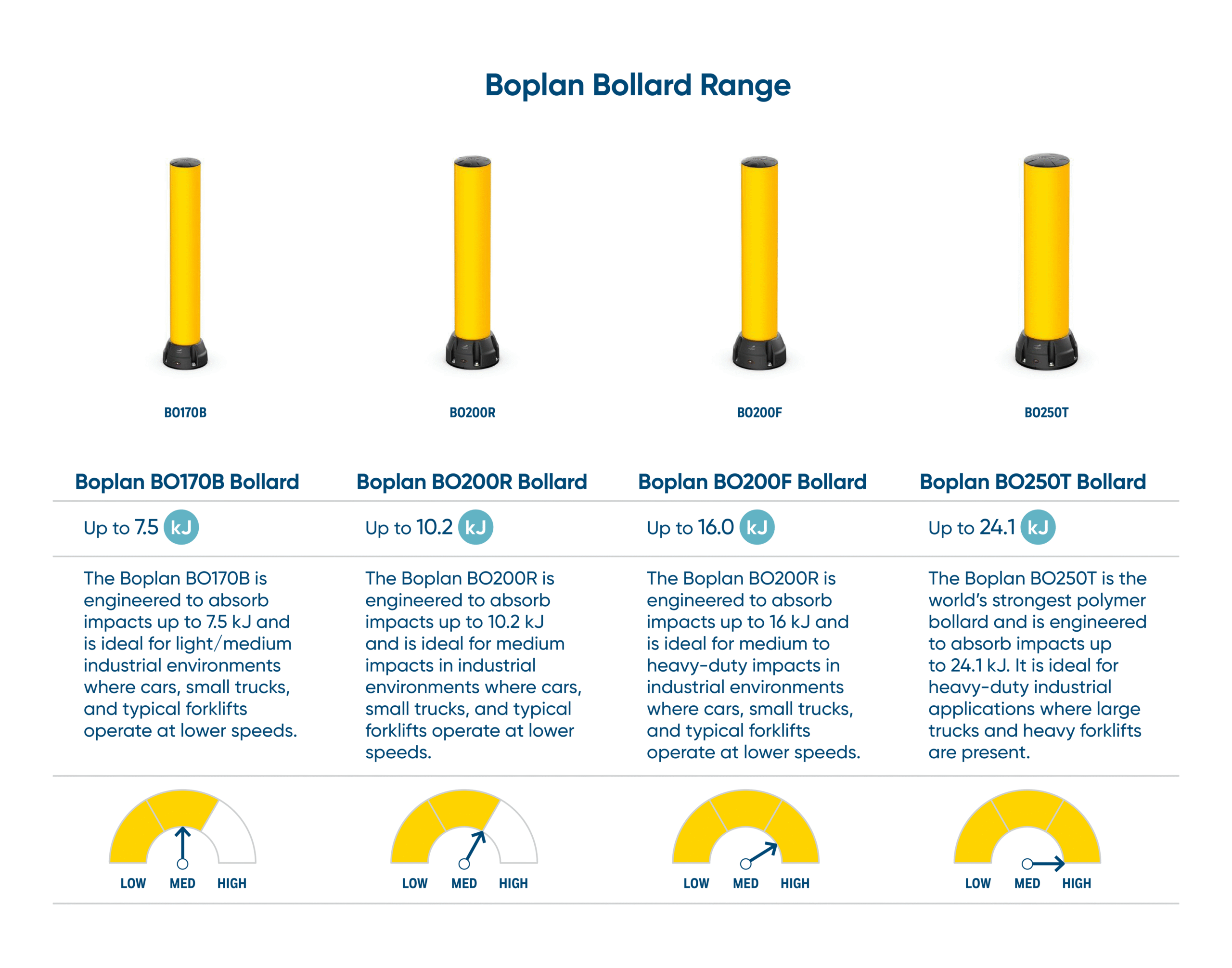
How Much Do Boplan Bollards Cost?
Our Boplan bollards range from $733 to $1,676, depending on the model you need. For an accurate quote, get in touch with our team, who can help confirm the appropriate specification and provide a detailed quote.
Boplan Bollards: Maintenance and Repairs
By absorbing that impact, the bolts experience less pressure and a lower risk of ripping out of the concrete surface. As a result, you save on maintenance costs, labour, and operational downtime.
How to Install Energy-Absorbing Bollards
For any bollard to absorb impact effectively, it must be installed in concrete. You should never install them in asphalt, as it is far weaker and will likely cause the bollard to pull out of the ground when struck, damaging both the bollard and the surface beneath.
Our energy-absorbing bollards are surface-mounted, meaning you don’t need to drill a hole to insert them into the ground. However, if you’re installing a bollard in an area without an existing concrete slab, you’ll need to pour a concrete footing to mount it to, or a concrete plinth if you are installing an entire run of bollards.
Installing a SlowStop or Boplan bollard is a speedy, easy process, with one bollard typically taking just 20 minutes to install into existing concrete.
If you would like help with installation, our team can assist you. However, they are straightforward to install on-site yourself. As long as they’re installed correctly, they are designed to last the distance.
Related Content: “Ready to Install Safety Barriers & Bollards? Prep Your Site in 10 Steps.”
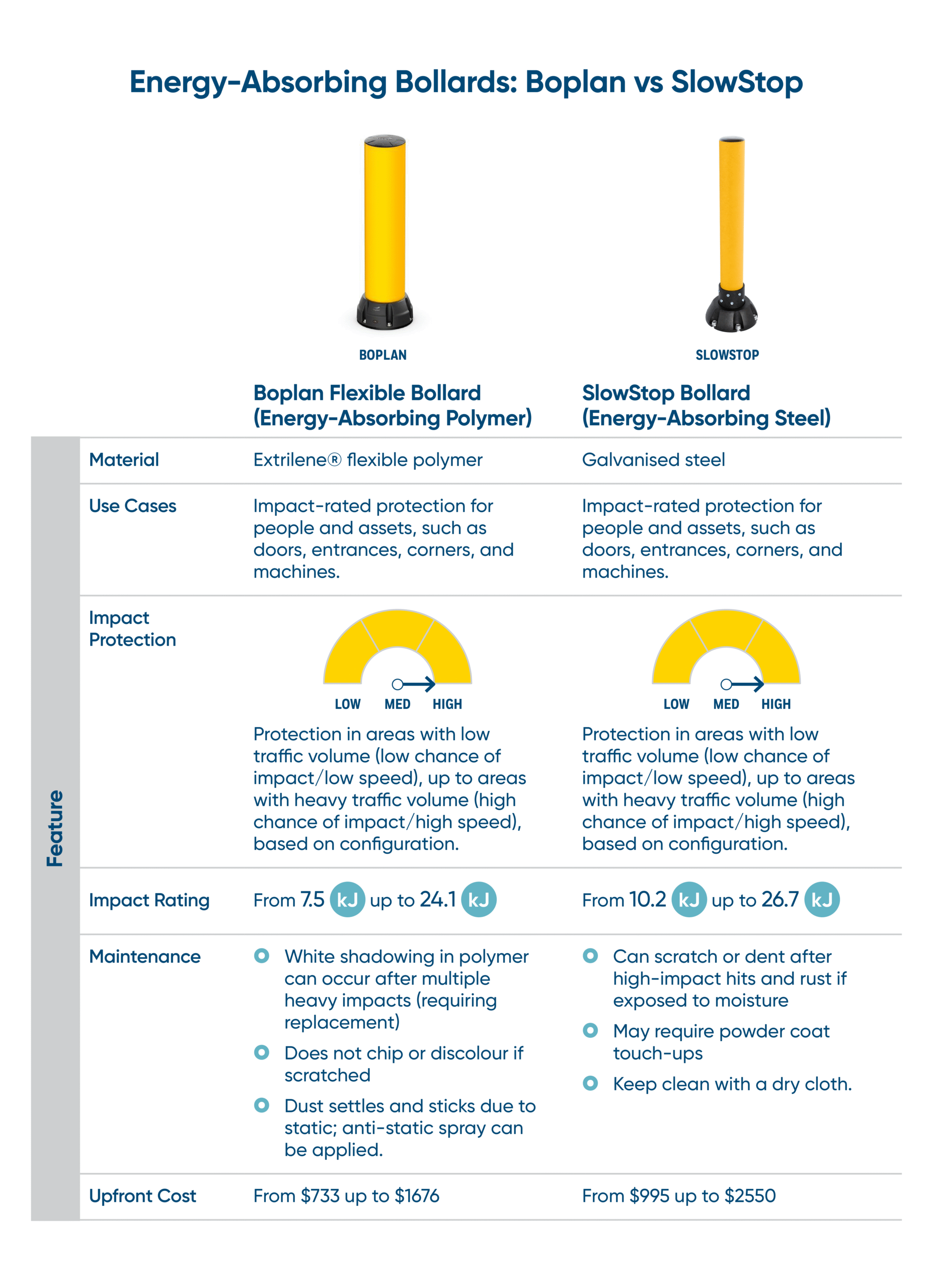
SlowStop vs Boplan: A Comprehensive Comparison
The table below outlines the key differences between SlowStop and Boplan energy-absorbing bollards.
Which Bollard Is Right for My Site?
When it comes to protecting people, infrastructure, and equipment, the real risk isn’t just the impact itself; it’s choosing a bollard that isn’t designed to withstand that impact.
Standard steel bollards have their place in low-risk areas, or as a cost-effective solution, but in busy industrial environments where impacts are likely, energy-absorbing bollards are the smarter, safer long-term option. They reduce damage, protect concrete, and help you avoid the ongoing cost and disruption of replacements and repairs.
Both SlowStop and Boplan offer proven energy-absorbing performance, but they solve the problem in slightly different ways.
- SlowStop Steel Bollards: well-suited to high-impact, heavy-duty applications that require maximum resistance.
- Boplan Flexible Polymer Bollards: suitable for the same purpose, but are particularly well-suited for cold storage or food-related facilities, and are available at a lower price point.
Making the correct choice comes down to your site’s risk profile: vehicle types, speeds, operating conditions, and what you’re protecting. If you match the bollard to the real-world hazards on your site, you can’t go wrong.
If you’re looking for more support in deciding which bollard is right for your site, get in touch with our team so we can understand your situation and help you protect your people and assets.
