


Client: Minus 1
Location: Minchinbury, NSW, Australia
With over 30 years of providing cold storage supply chain support across Australia, Minus 1 is an industry leader in logistics, storage optimisation and end-to-end refrigerated transportation.
With sites in multiple states, the company’s success doesn’t just rely on providing top-notch service—it’s also about ensuring that these high-functioning, fast-moving facilities operate safely and efficiently at all times.
After the construction of one of their most recent facilities in Michinbury, NSW, Minus 1 recognised that the safety measures put in place during the build weren’t robust enough to prevent harm. That’s when they reached out to our team at Vanguard.
Our AU Workplace Safety Division Manager, Jared Muller, headed to the new site to meet with Minus 1’s Safety Manager and walk the site to better understand the situation. Seeing these risks firsthand and speaking with key stakeholders enabled us to develop a plan to significantly improve the site’s safety and efficiency.
Client Challenge:
When the Minchinbury facility was first built, two safety controls were implemented:
- Internally: A low-height, steel box-section barrier was installed throughout the site to protect cold storage walls.
- Externally: Painted lines were used to create a visual walkway to separate pedestrians and vehicles when accessing the facility (the pedestrian door and vehicle roller door were side-by-side).
These safety controls presented the following challenges:
- Pedestrians kept stepping over the barrier into operational zones.
- The height of the barrier became a tripping hazard for pedestrians.
- The barrier configuration (low height, no impact protection) provided insufficient physical separation between pedestrians and forklifts.
- Painted lines at external access points offered no physical protective barrier between pedestrians and vehicles or forklifts.
Solutions Offered:
Like many facilities we visit, the assumption is that installing a W-Beam Barrier, also known as ‘Armco’, will be enough to offer the level of protection an internal area requires. What they often don’t know is that there are better barrier alternatives designed to protect people and assets, specifically in industrial environments.
While W Beam may be suitable for outdoor use, we challenged this idea by suggesting a more appropriate internal solution. Our recommendations were as follows, and were swiftly adopted following consultation and careful consideration of the project budget.
Pedestrian Protection in Internal Operational Zones
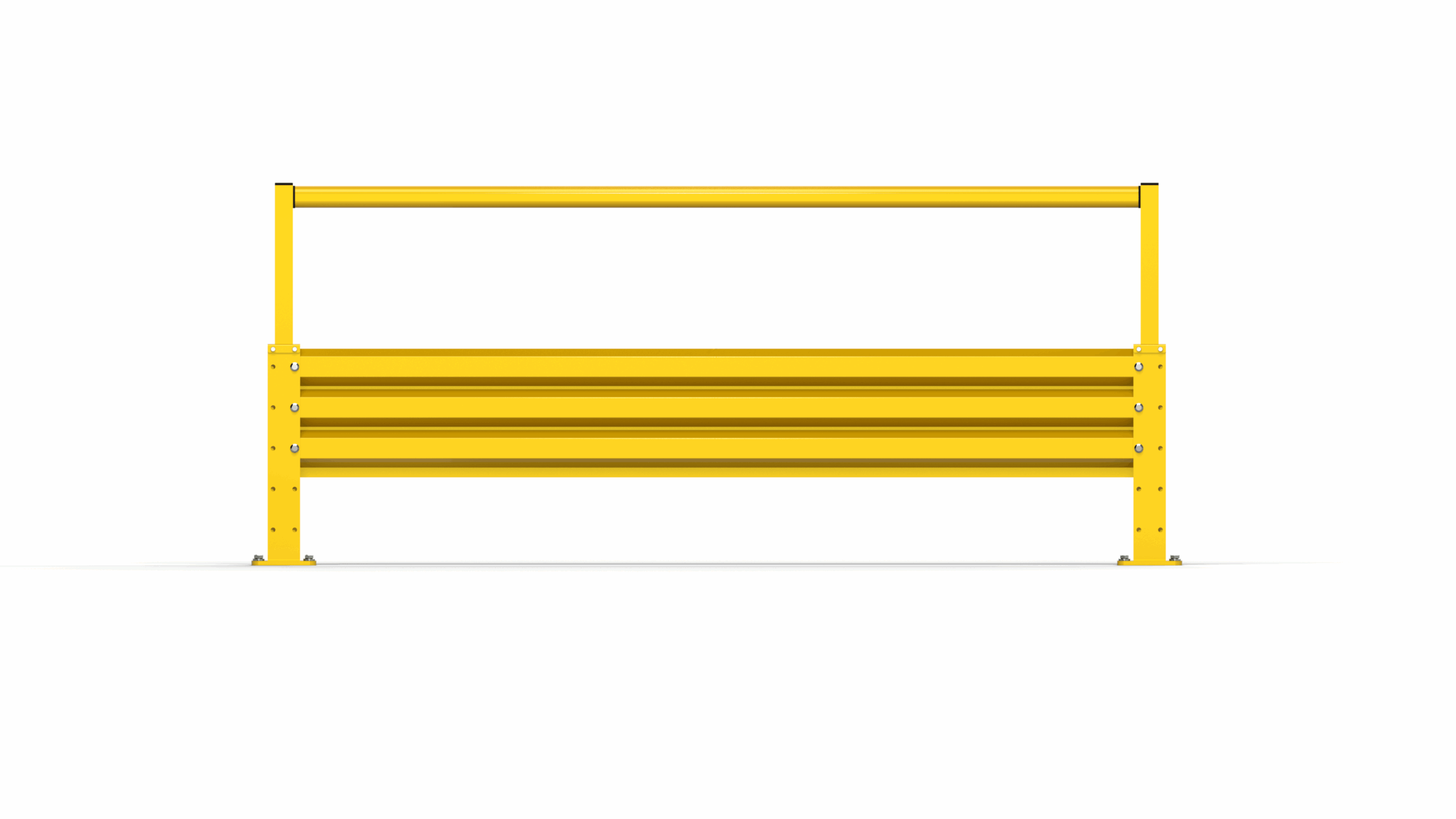
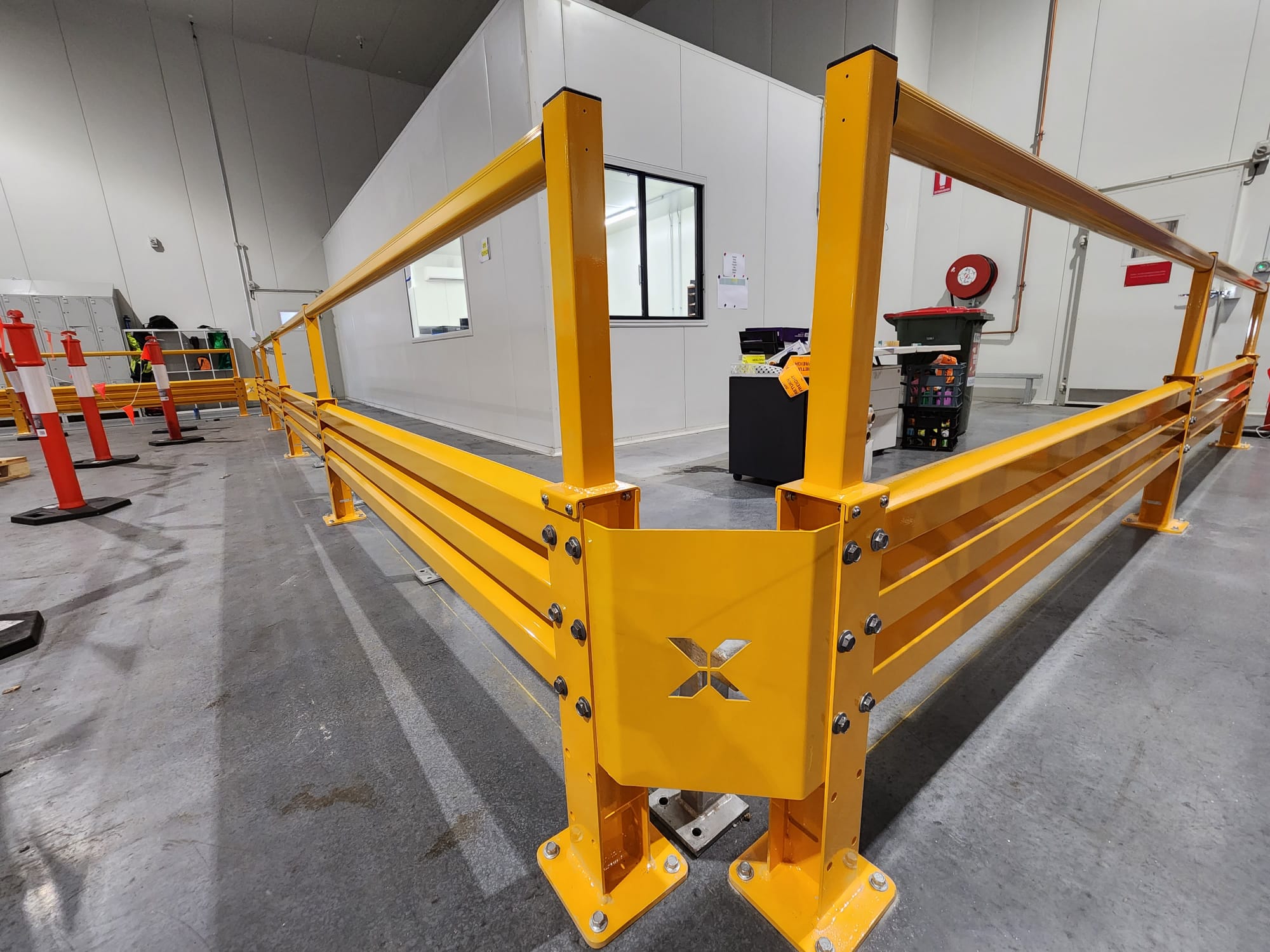
To create a clear, protected walkway in areas with no physical protection for pedestrians from forklifts, Minus 1 installed a series of ForkSafe 600-B barriers.
Because of ForkSafe’s modular design, the team were able to create well-connected, clearly demarcated walkways, including from the office and lunchroom to the facility’s operational zones.
Slim in style, the barrier freed up a whole lot of operational space that would have been lost if a bulky W-Beam Barrier had been installed instead. At 1 metre high, the 600-B provided physical protection for pedestrians moving around the site in case a forklift encroached on the walkway. It also prevented pedestrians from stepping over the existing steel box-section barrier and into the line of traffic.
Impact-rated to Match Risk
The ForkSafe barrier system is impact-tested in accordance with PAS 13. Unlike other standard testing standards (such as Finite Element Analysis (FEA) or AS/NZ 1170), PAS 13 is specifically designed to measure barrier strength and durability against forklift and other MHE impact in industrial environments—not just vehicles.
These barriers are also equipped with a unique Crumple Zone Technology (CZT), designed to absorb impact and further reduce the risk of shock to the forklift, while protecting concrete flooring from blowing out.
Reduced Operational Footprint
In bright safety yellow for high visibility, the slim design of the 600-B allowed Minus 1 to keep their operational footprint low—a game-changer for tight spaces with lots of movement.
Customisable for Future Plans
As for changing layouts and growing safety needs, as budget allows in the future, the Minus 1 team will be able to upgrade to the 600-D configuration for additional protection from forklift tynes.
External Access Protection Vehicle Access
As a temporary replacement for painted lines, Minus 1 introduced t-top bollards and flagging at the external accessway to create a visual barrier between pedestrians and vehicles. While this served as a visual guide, it did not provide adequate impact protection. To address this risk, the team installed the same 600-B ForkSafe barrier as inside the facility between the pedestrian and vehicle accessway to create a clear, impact-rated walkway.
The Outcome
Minus 1’s story is a classic case for why it’s so crucial to get the right safety controls in place for the situation from the start of any project. If installing the ForkSafe 600-B barriers to create internal and external walkways had been done from the beginning, there would have been significant cost savings and a lower risk of harm.
However, Minus 1’s openness to a smarter, safer, and more efficient alternative enabled them to implement a superior, customisable system that will adequately protect their people and assets, keep traffic moving smoothly, and significantly reduce their operational footprint and long-term costs.
If you need support mitigating safety risks and maximising efficiency on your site, we’re here to help. Get in touch with our team so we can understand your situation and work together to develop a comprehensive plan within your budget.
Unsure how our process works? Check out Vanguard’s 5-Step Safety Design Video.
To learn more about our ForkSafe range, read “The ForkSafe Barrier Range: A Comprehensive Overview.”
