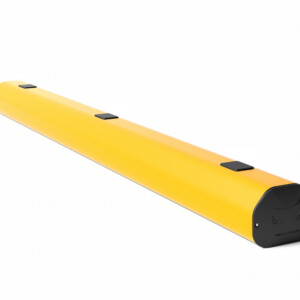
Flexible Bollard.
CODE:
Flexible Bollards mark out lanes, walkways and hazards in low-speed areas where vehicles work close to people and structures. Car parks, loading zones and logistics yards are where they earn their keep.
The bollard is moulded in one piece from flexible polyurethane. When a vehicle clips it, it bends and rebounds rather than snapping, so you’re not replacing posts or repairing panels after every bump. Built-in reflective bands keep it visible after dark.
It’s a delineator, not a barrier. It tells drivers where to go; it won’t stop a vehicle. If you need to physically protect people, racking or buildings, talk to us about steel or energy-absorbing bollards instead.
Key Features
- One-piece moulded polyurethane: no joints or pins to fail
- Flexes and rebounds on impact, limiting damage to the bollard and the vehicle
- Reflective bands for night-time visibility
- Hi-vis orange for clear separation of vehicle and pedestrian zones
- Surface-mounted with three fixings into asphalt, bitumen or concrete
- Two heights: 750mm and 1000mm
- Cost-effective delineation for low-speed, lower-impact areas
Typical applications
- Car park lane and bay delineation
- Separating walkways from vehicle routes
- Highlighting hazards in tight turning areas
- Loading docks and logistics yards
Options
Spec Sheets
Options


Spec Sheets
Accessories
FAQs.
What are Flexible Bollards made of?
Flexible polyurethane (PU), moulded in one piece with reflective bands built in.
What happens when a vehicle hits one?
It bends over and springs back to upright. That limits damage to both the bollard and the vehicle, so a minor bump in a car park doesn't mean a replacement.
Will it stop a vehicle?
No. It's a visual guide for drivers, not a protective barrier. To protect people, racking or buildings from impact, look at our steel or energy-absorbing bollards.
How are they installed?
Surface-mounted with 3 M10 x 75mm fasteners through the base. Use coach screws and plugs (1911-063) for asphalt or bitumen, or Anka Screws (1911-035) for concrete. Full steps are on the spec sheet.
750mm or 1000mm?
750mm suits most car parks and walkways. The 1000mm sits higher in a driver's line of sight, which helps with higher-cab vehicles such as vans and trucks.
You may also be interested in
What our clients are saying.
Hear what our customers have to say about working with Vanguard to get their safety projects completed.