

In a workplace where there is a high likelihood of collisions between heavy forklifts and structures, equipment, or people, you need a bollard built to withstand impact and remain in the ground when struck.
When a standard steel bollard won’t cut it, an energy-absorbing SlowStop bollard will.
In our previous article, we broke down the features of standard steel bollards and energy-absorbing bollards, how they differ, and the factors that determine which option offers the most protection for your site.
If you haven’t read it yet, this is a good place to start. You can check it out HERE!
In this article, we cover:
- How Do SlowStop Bollards Work?
- Where Would You Use a SlowStop Bollard?
- How Much Do SlowStops Cost, and Are They Worth It?
- Will a SlowStop Bollard Withstand Impact on My Site?
How Do SlowStop Bollards Work?
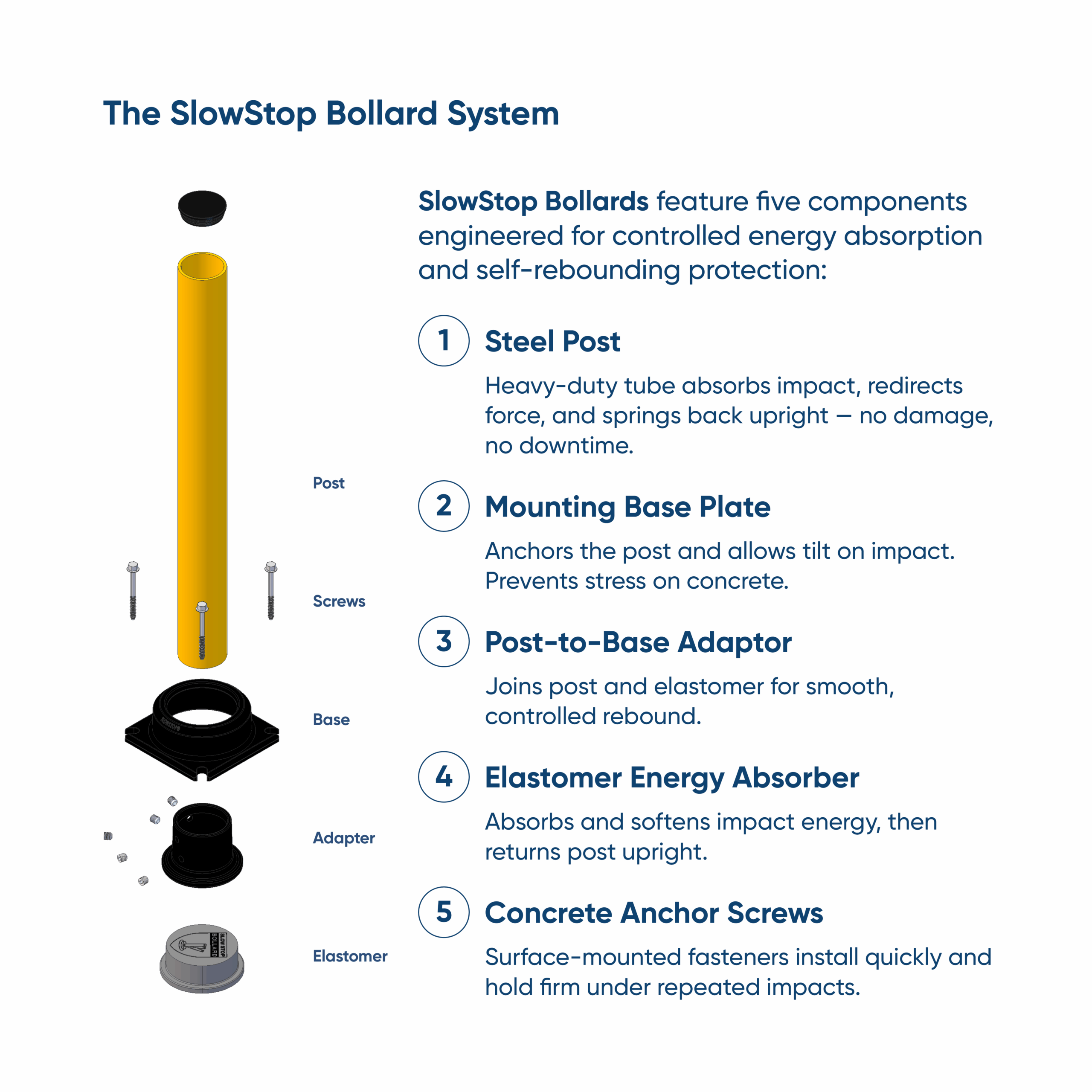
SlowStop bollards are the world’s only full-steel rebounding bollards. Extremely heavy-duty, they make up a unique four-part system that starts with an elastomer buffer pad at the base.
This buffer pad acts much like a base isolator used to earthquake-proof a building structure: when the steel bollard pipe is struck, the pad absorbs the energy, allowing the pipe to rebound to its original position.
In doing so, it removes the risk of ripping the bolts and bollard out of the ground and damaging the concrete.
We’ve seen this reality play out across hundreds of sites across New Zealand and Australia. One example in particular occurred at a meat processing plant, where SlowStops were used to protect a series of robotic equipment used to wrap pallets.
A forklift driver was travelling at a reasonable speed, carrying a load, and without a seatbelt on, when he wasn’t watching where he was going and collided with a SlowStop.
The plant manager shared that, thanks to the bollard’s energy-absorbing qualities, it reduced impact on the forklift driver and protected critical infrastructure without damaging the concrete—a win-win for overall safety.
The SlowStop Bollard Four-Part System
Here’s how the SlowStop Bollard Four-Part System works:
WATCH VIDEO: SlowStop Bollards Overview
Where Would You Use a SlowStop Bollard?
SlowStop Bollards are most effective in areas where critical assets need protection, space is tight, and there’s a lot of vehicle, forklift, and other MHE movement. Ultimately, they work best in locations where they are highly likely to be hit.
Warehouses, plants, packhouses and manufacturing facilities are all home to expensive equipment that you want to avoid damaging. Whether it’s a roller door, a conveyor belt, or an automated guided vehicle (AGV), SlowStop bollards offer maximum impact protection.
Other areas SlowStops can be installed:
- Cold storage facilities (safe from moisture)
- Ports and Marinas (salt-resistant)
- Airports
- Warehouses and Distribution Centres
- Food Manufacturers
SlowStops also protect critical infrastructure, such as:
- Electric vehicle charging stations
- Fuel stops (including heavy truck stops)
- Power stations
- Structural beams
- Retail stores
- Fences
- Robotic equipment
- Overhead gantry crane frames
Why Not Use a Standard Steel Bollard?
In an environment where the risk of a bollard getting hit is low, a standard (non-energy-absorbing) steel bollard will offer enough protection.
However, in a high-risk environment, standard steel bollards can be scraped, dented, and ripped out of the ground following heavy impact. Not only will you have to replace standard steel bollards regularly, but you’ll also have to fix damaged concrete, which is expensive and inconvenient.
Can You Use SlowStops in a Cold or Wet Environment?
If a standard steel bollard is ripped out of concrete in a cold storage facility, replacing the concrete is a significant task. The concrete will not cure in these temperatures, which means operations must be stopped, resulting in disruption and expensive time and labour costs. Because SlowStops won’t rip out of the ground, you avoid these issues entirely.
How Much Do SlowStops Cost, and Are They Worth It?
SlowStops come with a much higher upfront cost than standard steel bollards. This is due to the energy-absorbing technology and its ability to withstand heavy impact. However, the greater initial investment is guaranteed to save you money in the long term. Why? Because you don’t have to constantly spend money replacing the bollard or the concrete beneath it when it gets hit.
SlowStop Bollard Price Range: $995-2550
Standard Steel Bollard Price Range: $185-$595
Which Size Bollard Should I Choose?
SlowStop bollards are available in three diameters: 101mm, 141mm, and 168mm. As they increase in size, the steel pipe, base, and concrete fixings also increase in size. Each SlowStop has a different impact rating—the larger the bollard, the more protection it provides. Below, we cover the impact ratings (kJs) for each SlowStop and how they translate into vehicle weight and speed.
SlowStop Bollard 101mm
The 101mm SlowStop Bollard is designed to absorb impacts of up to 10.2 kJ, making it ideal for medium industrial environments where cars, small trucks, and typical forklifts are present at lower speeds.
SlowStop Bollard 141mm
The 141mm SlowStop Bollard is designed to absorb impacts of up to 18 kJ, making it ideal for medium to heavy-duty industrial applications where cars, light trucks, and typical forklifts are present.
SlowStop Bollard 168mm
The 168mm SlowStop Bollard is the strongest surface-mount bollard on the global market. It’s built to absorb impacts up to 26.7 kJ, ideal for maximum protection in the most demanding applications such as large trucks and heavy forklifts.
What Level of Impact Protection Do I Need?
The capability of a SlowStop bollard to withstand a hit is based on its tested impact rating.
An impact rating is measured in joules (kinetic energy/kJ). It is calculated based on the vehicle’s mass (in kilograms), speed (in kilometres per hour), and the impact angle (in degrees).
Use this table to see how the impact rating (kJ) translates to real-world vehicle mass and speed. It’s important to note that all of our impact ratings are based on a 90° impact.
By following this guide, you’ll have confidence that the SlowStop Bollard you choose is suitable for the area you’re installing it in, the types of vehicles operating in that area, and the speed they’re travelling.

How Do You Install a SlowStop?
Installing a SlowStop is a speedy and easy process. Typically, one bollard can take 20 minutes to install into existing concrete.
For the impact rating to be accurate, SlowStops must be installed into concrete; they cannot be installed into asphalt.
If you do not have a concrete surface, you will need to pour concrete, either for individual bollards or as a concrete slab, depending on how many you are installing in an area.
The SlowStop Bollard kit comes with all the components you need to assemble it, including bolts for securing it to the concrete surface. One of the best things about the SlowStop Bollard makeup is that, unlike some other market look-alikes, there are no expendable parts.
If you would like help with installation, our team can assist you. However, they are very simple to install on-site yourself. As long as they’re installed correctly, the SlowStop is designed to last the distance.
Once the SlowStop is installed, it’s good to go. Generally, no maintenance is required. Most people don’t worry about the cosmetic aspect. After all, with the bollard likely to take multiple hits, scratches mean it’s doing its job. However, you may want to touch up the yellow powder coat on the steel tube itself.
For more information on how to install SlowStops, check out our SlowStop Installation Guide.
WATCH VIDEO: How to Install our SlowStop Bollards
Are SlowStop Bollards Suitable for My Site?
Dealing with bollards that bend, break, or rip clean out of the ground comes with a string of headache-inducing consequences—constant replacements, costly concrete repairs, and unexpected downtime. The good news is that these frustrations can be avoided by using the right bollard for the environment in which it’s being installed.
SlowStop bollards are a no-brainer when you want to protect expensive assets and shelter people from vehicle, forklift, or other MHE impact. What they offer in tight spaces where there’s lots of movement is the assurance that they won’t fail, and will be able to withstand all the knocks and bumps that occur on a busy site.
While they do come at a significantly higher cost than standard steel bollards, you certainly get what you pay for. From Day 1, you will save money in the long run by eliminating the need for expensive bollard and concrete surface replacements.
Wondering if there are other energy absorbing bollards available? Find out the difference between SlowStop Steel Bollards and Boplan Flexible Bollards in our comparison guide HERE!
If you want more information on our SlowStop bollards, whether it’s what size to get, how many you need, or where to place them on your site, we’re here to help. Get in touch with our team, and we’ll set you on the right track to creating a safer, more efficient site.
